Commercial roof coating & restoration in Houston
Fluid-applied restoration over single-ply, modified bitumen, built-up and metal. Years of service life back on the roof you already own, with no tear-off and the building open the whole time.
On this page
01
Restore the roof instead of replacing it
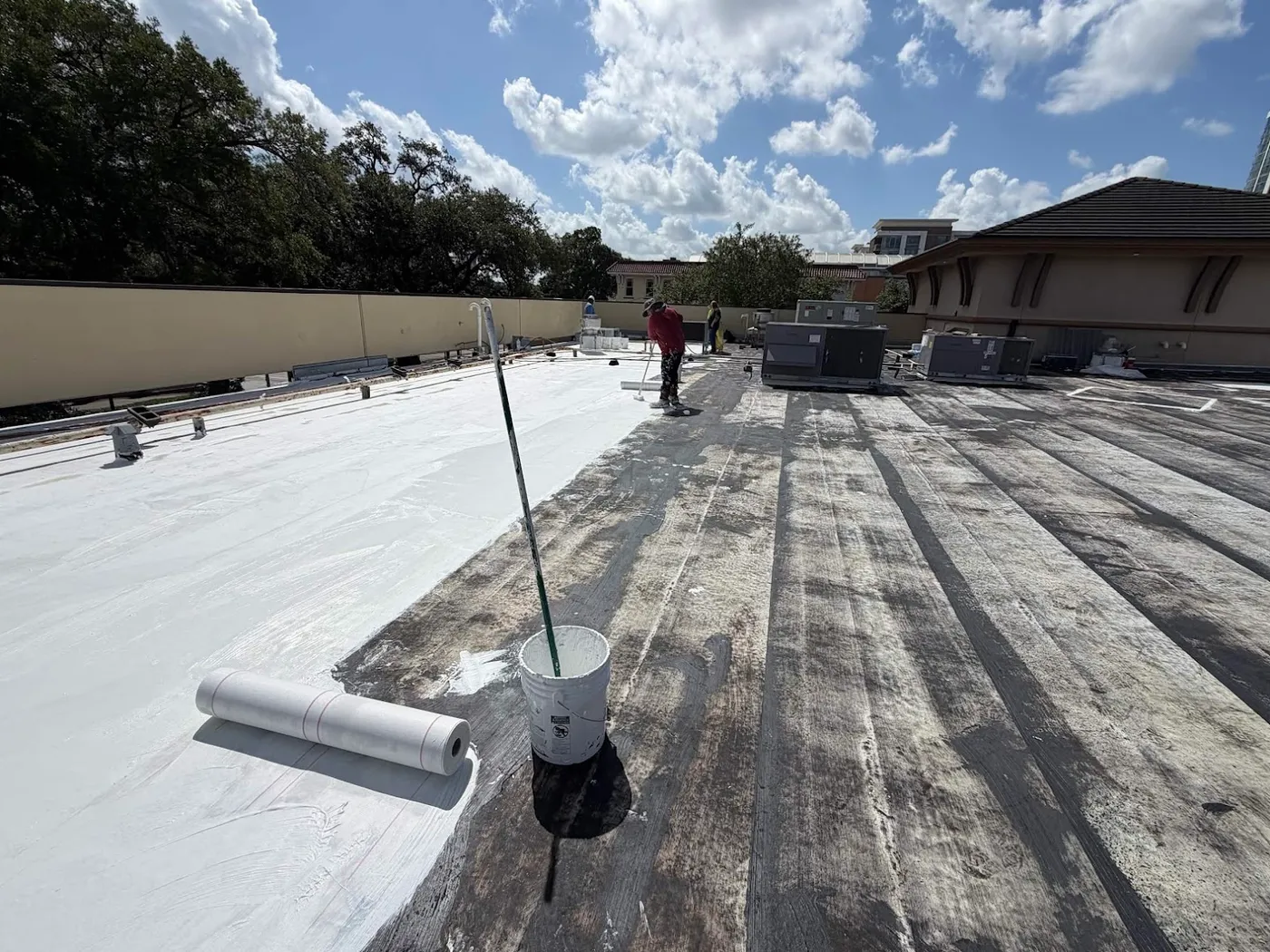
A commercial roof coating is not a paint job and it is not a patch. It is a restoration. The roof gets cleaned, the details get repaired and reinforced, and a fluid-applied membrane goes on over the roof that is already there. On a Houston commercial building with a sound deck and dry insulation, that puts years of service life back on a roof you already own.
Most of our restoration work happens on occupied commercial buildings. There are no dumpsters in the lot and no open deck over your tenants, so warehouses keep shipping and strip centers and medical offices stay open through the job.
Coating is the method. Restoration is what you are buying: the same deck and the same insulation, under a new membrane with a manufacturer warranty on it. We restore TPO and PVC single-ply, modified bitumen, built-up and gravel-surfaced roofs, and metal, on commercial and industrial buildings across the Houston metro and Galveston County.
02
What a fluid-applied restoration actually is
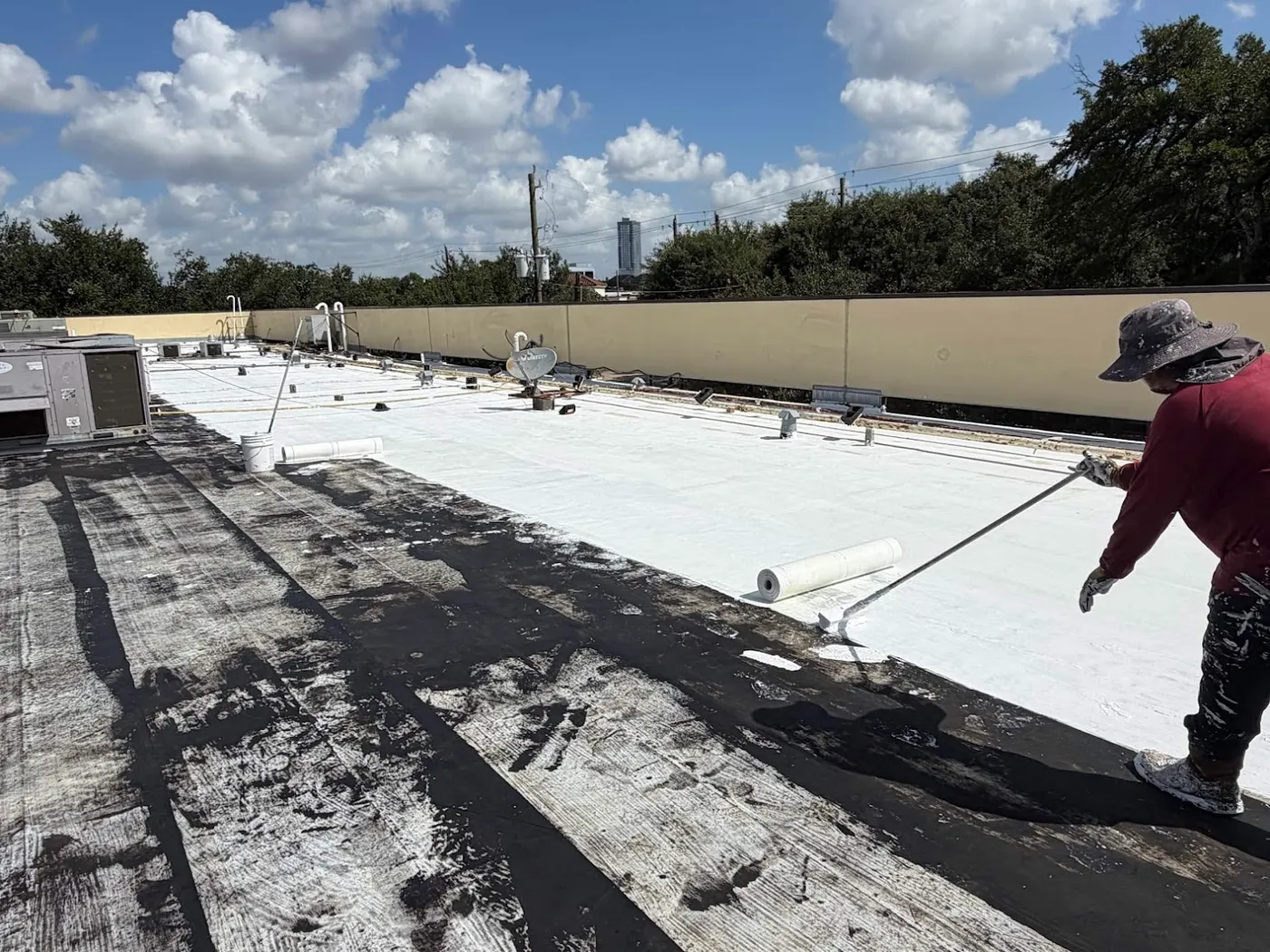
Five steps, done in order.
First the roof gets washed. Chalk, grease and biological growth all come off, and on a strip center that means degreasing the membrane downwind of every kitchen exhaust. A coating over a dirty roof does not bond. It peels off in sheets.
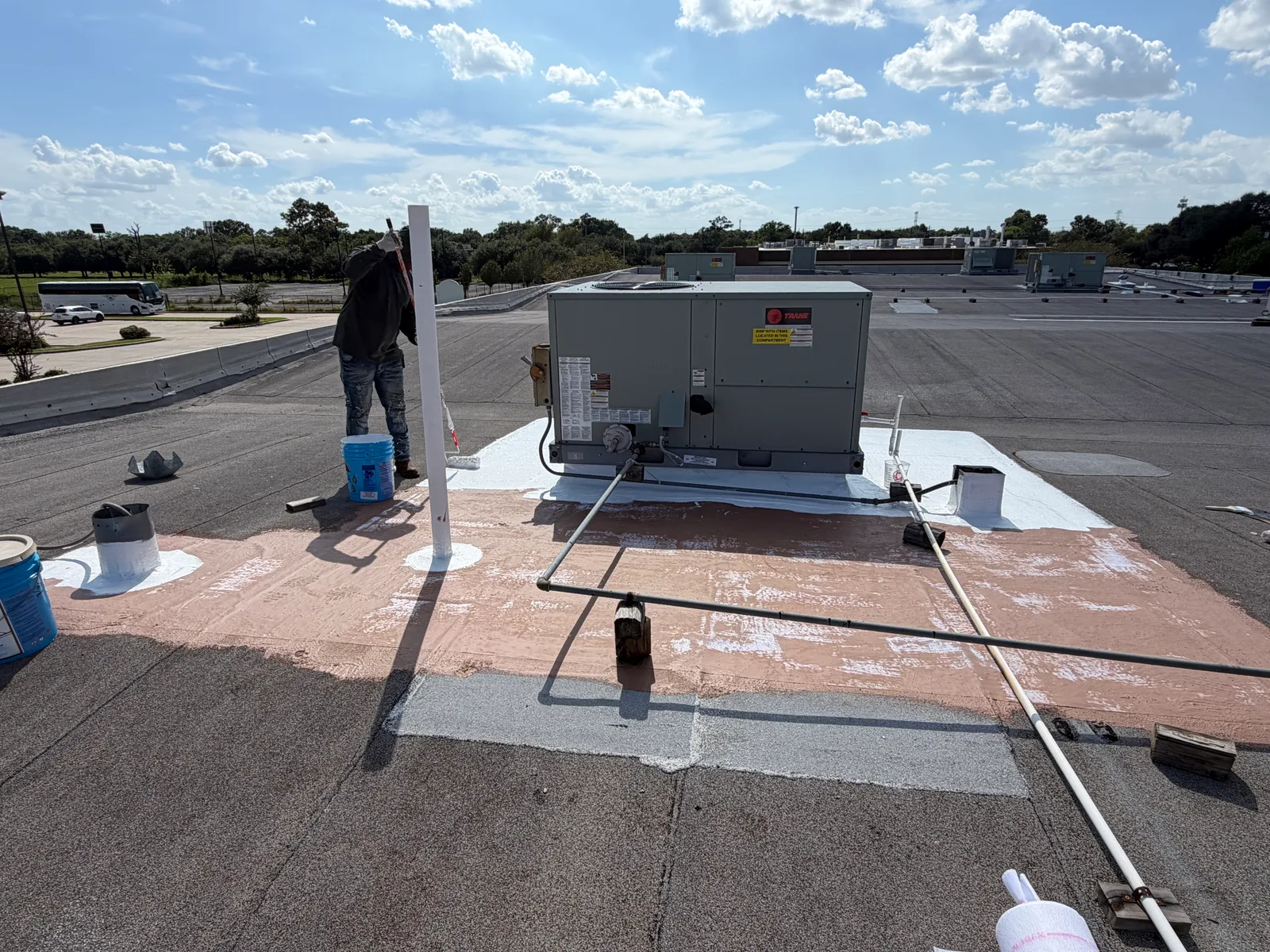
Second, the details get fixed rather than covered: open seams, split base flashing, backed-out fasteners, dead pitch pockets, torn curb flashing. That is commercial roof repair work, done before any coating goes on. Coating over a bad detail only puts the leak under a more expensive roof.
Third, the reinforcing. Seams, curbs, pipes, drains and wall terminations get a coat, a layer of fabric bedded into it, and another coat over the top. It is the first thing dropped when a bid comes in low, and reinforced details are most of what you are paying for.
Fourth, the field. On modified bitumen and built-up roofs, Wade's usual build is a hybrid. An asphalt emulsion base goes down with fabric rolled in, then acrylic with a second layer of fabric, then a final acrylic coat. The emulsion grips the old roof, the acrylic takes the sun, and the fabric makes it a membrane instead of a film. TPO and PVC roofs get no emulsion; their coating system usually starts with a primer.
It is built to the thickness the manufacturer specifies, measured in mils, because thickness is what the warranty is written against.
Fifth, it cures into one continuous membrane, with no laps left to open and a bright white surface that sends the sun back instead of holding it.
03
The roofs we restore, and what each one needs
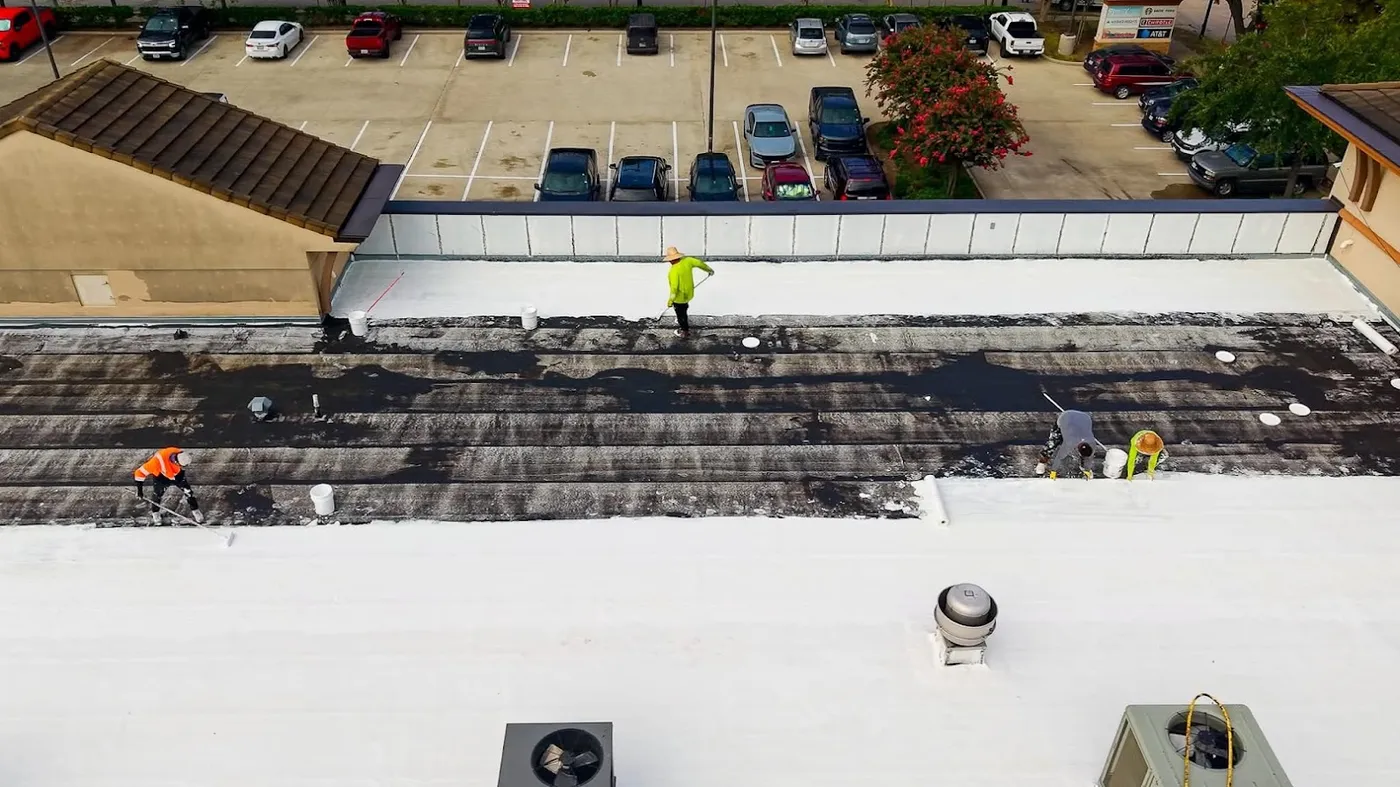
Restoration goes over most of what sits on Houston's commercial and industrial buildings. Each system fails differently, so each one gets prepped differently.
TPO and PVC. An aging single-ply roof often goes chalky and stiff on top while the insulation underneath stays dry, and the seams and curb flashing give first. With a sound field and fixable details, it is one of the best restoration candidates there is. If you are not sure how much life is left in yours, a documented roof inspection answers that.
Modified bitumen and built-up. The granules are gone in the traffic paths, the surfacing has cracked, and years of mastic sit around the drains and base flashing. A fabric-reinforced system bridges the cracking instead of sitting down in it. On a gravel-surfaced built-up roof the gravel comes off or gets embedded first, and that gets priced up front.
Metal. Standing seam and R-panel roofs run on their own playbook, covered in full, cost per square foot included, on the metal roof coating and restoration page.
One condition cuts across all of them: water still standing two days after the rain does not go away under a coating. A blocked drain or crushed insulation gets fixed first. A sagging deck we document, then either quote the structural repair or work around it, depending on how bad it is. Flat roof and drainage work is part of the restoration, not an extra discovered afterward.
Not sure which of those your roof is?
It takes a walk on the roof, not a look at an aerial. We photograph what is up there, check the drains and the insulation, and tell you whether restoration is on the table for your building.
04
Silicone, acrylic or fabric-reinforced
Three chemistries cover almost everything we install, and the roof picks, not the office.
- Silicone
- Silicone holds up where water sits. It does not break down under standing water the way an acrylic does, which on a low-slope Houston roof with a few soft spots is usually the deciding point. It holds dirt, so it gives up some reflectivity over the years, and it costs more per square foot.
- Acrylic
- Acrylic is the workhorse on roofs that drain properly: cheaper, brighter and easy to recoat. What it will not do is live under permanent standing water.
- Fabric-reinforced
- Fabric bedded into the coating, at the details on every job and across the whole field on older roofs with a lot of movement or cracking. That builds a membrane rather than a film, and it can generally be cleaned and recoated later rather than torn off.
Plenty of Houston roofs get more than one across a single field: reinforced details, silicone where water sits, acrylic where it sheds. Slope, drainage, deck movement and what is already up there decide it.
05
What a restoration costs, and what moves the number
Membrane restoration in the Houston market runs $4.50 to $8.00 per square foot. A tear-off and replacement of the same roof runs $15 to $20. Those are ranges because every roof gets priced off the roof, not over the phone. Every published price, with worked examples, is in our commercial roof cost guide.
Square footage comes first. Then prep: a chalked but clean TPO field is quick, a gravel-surfaced built-up roof is not. Then the detail count, because two roofs of the same size can be thousands of linear feet of reinforcing apart. Then the repairs before coating, the chemistry, and the warranty term, which is set by coating thickness.
The biggest tickets are also the clearest restoration decisions, and the gap between restoring and replacing is widest on them. That means distribution and warehouse roofs along the Grand Parkway and toward Brookshire, industrial roofs around the Ship Channel, and big-box and strip retail along I-10.
Metal is priced lower: a fluid-applied metal restoration runs $3.75 to $5.00 per square foot against $7 to $12 for a replacement. The detail is on the metal roof coating page.
You get the number in writing with the system named, the thickness specified and the warranty term stated, with the photos behind the recommendation.
Want the number for your roof?
We price off the roof, not off a chart. Tell us the building and roughly how much roof there is, and we will come walk it and put the system, the thickness and the warranty term in writing.
06
When coatings won't work
Coatings do not fix everything. Anyone willing to coat over soft decking or saturated insulation is selling you a very expensive delay.
Four things take a roof out of the running. Wet insulation, because a coating seals the water in and the deck keeps rotting under a roof that now looks new. A deck that has gone soft or is corroding through. Membrane that has failed across the field, leaving nothing sound to bond to. And too many layers already, where code will not allow another system.
So nobody should quote a coating from the parking lot or off an aerial photo. We walk the roof, pull the covers off the drains, and look at the underside of the deck wherever we can. Then we take core cuts to find out whether the insulation is wet, which is the difference between a restoration that works and water sealed into a building.
We have walked away from coating jobs and told the owner to replace instead, with photographs attached rather than as an opinion. When the numbers point at a tear-off, commercial roof replacement is a conversation we are glad to have. It is just not the one we start with.
Ask Wade directly whether you should replace and the answer starts in the same place every time: “I wouldn’t start with replacement. First we need to find out where the water is getting in, what shape the roof is actually in, and whether the leaks are isolated or the whole system is failing. If the roof can be repaired and bought more time, I’ll tell you that. If replacement is the smart move, I’ll show you why and give you the numbers.”
07
The coating systems we install, and their warranties
We are certified applicators for the fluid-applied systems we install: Karnak, Western Colloid, and IPC, which is based in Pearland. Manufacturers generally issue a system warranty only when an approved applicator installs their system to their specification and thickness. If a bid does not name the manufacturer and the system, nothing stands behind that roof except the contractor who sold it.
On the systems we install, those warranties can run 10 to 20 years with no dollar limit, so the manufacturer does not cap what it pays on a warranted repair. IPC also offers hail coverage up to 2 inches. The manufacturer approves each roof, and the term depends on the system and how it is built. A manufacturer warranty means the manufacturer stands behind the roof as well as the contractor who installed it. Get the term, the coverage and the exclusions in writing, including what it says about hail.
Many coating systems can be recoated when the term runs out. Whether that renews the warranty depends on the manufacturer and the system, so get that in writing too.
Warranties commonly carry conditions, so check yours. Keeping drains and details looked after is what a roof maintenance program is for. A drain blocked with a season of leaves will pond water on a silicone roof, and warranties generally do not cover neglect.
08
Restoring a metal roof?
Metal has its own failure pattern and its own playbook: fasteners, rust, reinforced seams, and chemistry picked for the slope. The metal page has the process, the chemistry comparison, the cost numbers and the warranty detail in one place.
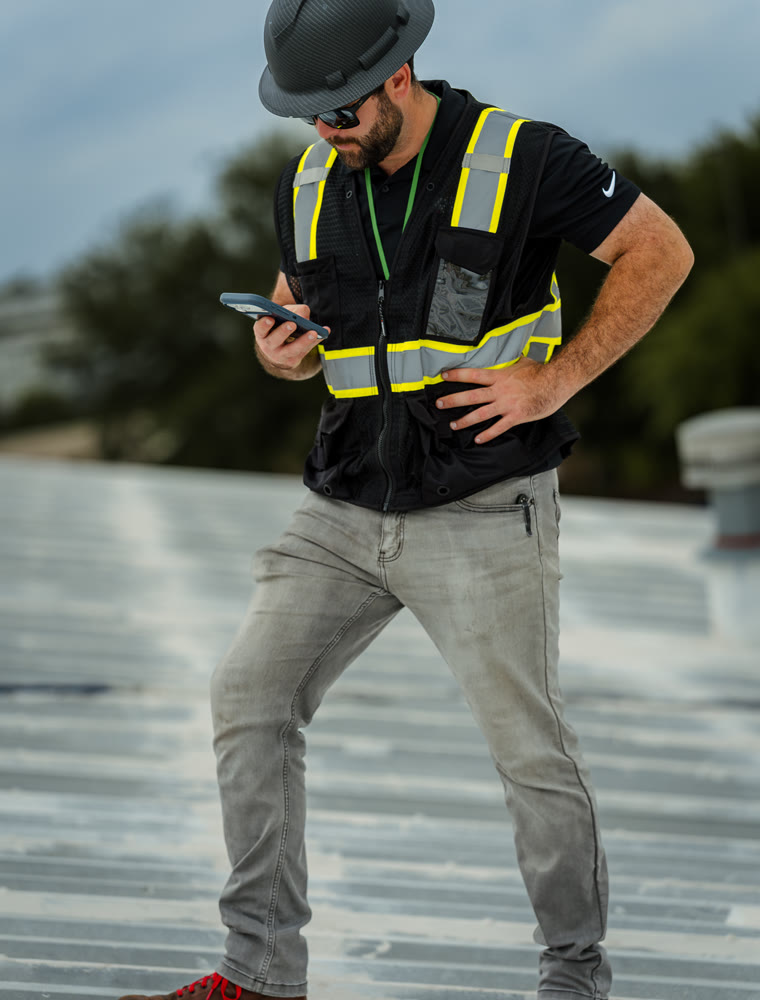
Who you are dealing with
Coons Roofing is a commercial-only roofing contractor working across the Houston metro. It is owned and run by Wade Coons, who is on every project from the first roof walk to the final walkthrough. There is no salesman between you and the person who looked at your roof.
Certified applicator for Versico, FiberTite, Duro-Last, Karnak, IPC, Western Colloid, Elevate and GAF. Fully insured with general liability and workers compensation coverage.
09
Commercial roof coating & restoration FAQs
What is the difference between a roof coating and a roof restoration?
A coating is the material. A restoration is the whole job. The roof is cleaned, the seams, flashing and penetrations repaired, and the details reinforced with fabric. Then the coating is built up over the field to a specified thickness. Buying a coating without the prep and detail work is how people end up with a white roof that leaks in the same places it always did.
What does a commercial roof restoration cost in Houston?
In the Houston market, a membrane restoration runs $4.50 to $8.00 per square foot against $15 to $20 to tear off and replace. A fluid-applied metal restoration runs $3.75 to $5.00 per square foot against $7 to $12 for a replacement. Where a roof lands depends on square footage, prep and repair, the number of curbs, drains and penetrations, the chemistry and the warranty term. Every roof gets walked first, and the figure comes in writing.
Can you coat a roof that is already leaking?
Usually, but not by coating over the leak. We find where the water is actually getting in first and repair it, because a coating is a waterproofing system and not a leak detector. If the leak has been running long enough to wet the insulation underneath, that section has to come out before anything goes on top. That is what the core cuts during the assessment are for.
How do I know whether my roof is a candidate for restoration?
Three things decide it: the deck is sound, the insulation is dry, and the roof is failing at the details rather than across the entire field. A weathered TPO roof with chalked membrane, split seams and dry insulation is a good candidate. A roof with saturated insulation, soft decking or field-wide membrane failure is not. A walk on the roof and a few core cuts tell you which one you have.
How long does a restoration take, and does my building have to close?
The building stays open. There is no tear-off, so the roof is never opened up and left overnight, and there are no dumpsters in the lot. Duration comes down to square footage, how much prep and detail work the roof needs, and the weather. Coatings need a dry window and a surface temperature above the manufacturer's minimum, so Gulf Coast scheduling works around rain.
Will a reflective coating lower my cooling costs?
A white surface sends sunlight back instead of absorbing it, which lowers the roof's surface temperature and the heat driving into the building. How much shows up on the bill depends on the insulation, how much conditioned space sits below the roof, and the rooftop equipment. The difference is biggest on a single-story building that is air conditioned throughout, and smaller on a multi-story office.
Does coating my roof affect the warranty already on it?
It can. Some manufacturers approve a coating over their own system and some treat it as a modification. If your roof is still inside a manufacturer's warranty period, that gets checked before anyone quotes a restoration.
What areas do you cover for roof coating and restoration?
The Houston metro and Galveston County. That includes Katy, Sugar Land, Stafford, The Woodlands, Spring, Cypress, Tomball, Conroe, Pearland, League City and Pasadena. It also includes the Ship Channel and refinery corridor east of Houston, where the industrial roofs are largest. Same-day emergency response is available across the service area.

Still weighing restoring against replacing?
We walk the roof, cut it open where we need to, and show you both numbers with the photos behind them. If it should come off, we will tell you that instead.
10
Where we work across the metro
We cover Harris, Fort Bend, Montgomery, Galveston, Brazoria, and Waller counties. Pick your city for local detail on what we see on roofs there.
Related services

Schedule a free roof assessment
We'll walk your roof, take photos, and give you straight answers. The assessment is free when we are quoting the work.
We reply within 24 hours, usually the same day. No pressure, no sales visit you did not ask for, and we never sell your information.