Warehouse & industrial roofing in Houston
Warehouses, distribution centers and industrial buildings put a very large roof over stock, racking and equipment. We repair, restore and retrofit metal and low-slope industrial roofs, and we tell you when a tear-off is not needed.
On this page
01
What a big industrial roof changes
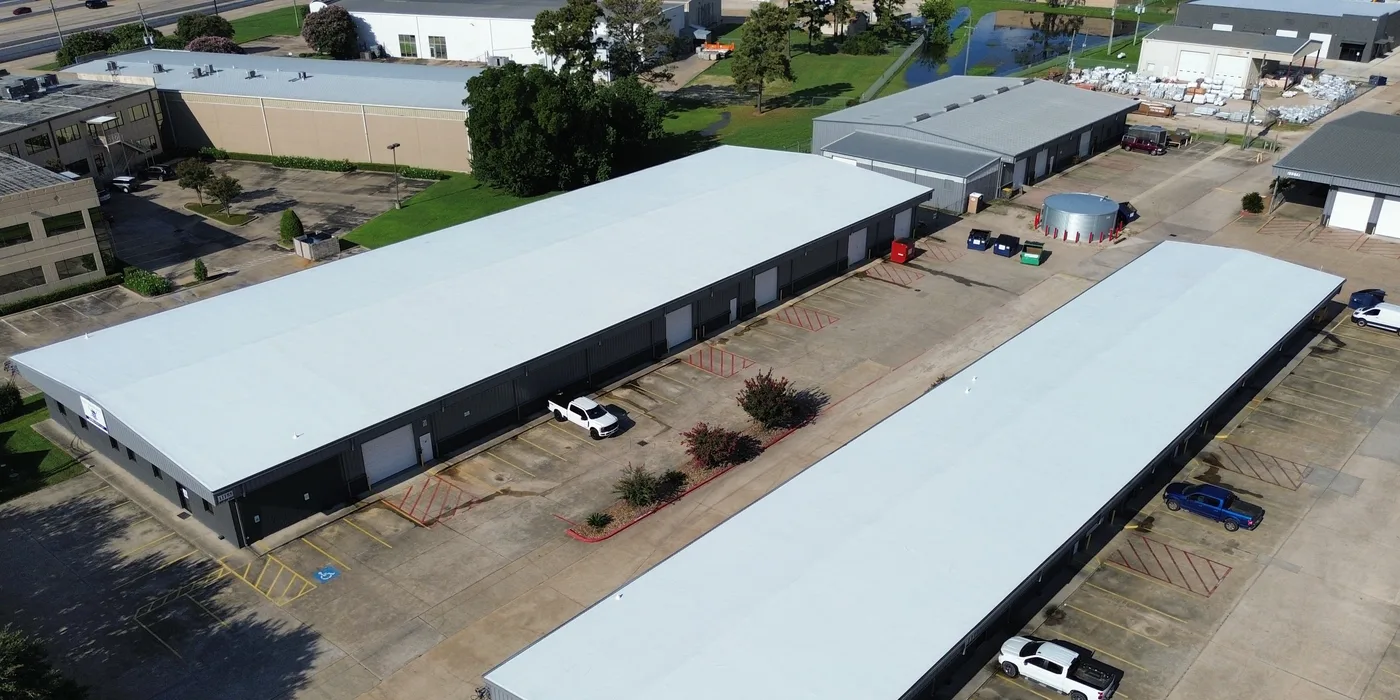
The roof on a Houston warehouse, distribution center or light industrial building is usually one of two kinds. Screw-down R-panel or standing seam metal on a steel frame, or a low-slope TPO, modified bitumen or built-up roof over steel deck. Either way it runs a long way without a break, and the same few details repeat across all of it.
On metal, those details are the screws and the laps. Row after row of exposed screws, each sealed by a washer that dries out in the sun, and a lap wherever one panel overlaps the next. On a membrane roof they are seams, curbs, skylights, expansion joints, and the flashing up every wall and parapet. Corners and edges catch the most wind, so edge metal and perimeter membrane are the first things to look at after a storm.
Size changes how a problem gets found, too. On a roof this long, water can get in at one bay and show up several bays away. So we walk the whole roof, not the corner above the complaint, and photograph what we find. Much of what turns up is ordinary commercial roof repair, and a standard repair generally runs $1,500 to $3,500.
If water is coming through the deck onto stock right now, skip the rest of this page. That is commercial roof leak repair, and it starts with a phone call, not the form.
02
Drainage on a shallow deck
Low-slope industrial roofs are built with very little fall. Rain has a long way to travel to an interior drain, a scupper or a gutter. Anything in its path leaves water behind: a drain packed with silt, a missing strainer, insulation crushed where crews cross to the units, or deck sagging between joists.
Standing water is heavy, and a large roof can hold a lot of it. It also sits for days against details built to shed water, not to sit under it, and it wears the membrane beneath it. On metal buildings the gutters and downspouts do the draining, and a gutter full of debris overflows at the eave.
The fix follows the cause. A blocked drain gets cleared and its strainer put back or replaced. Crushed insulation gets cut out and rebuilt. Where water needs another way off the roof, we cut in and flash a scupper; we do not do brick or block repair around it. A deck that has sagged is a structural problem: we document it and quote the structural repair, or work around it, depending on how severe the sag is.
The causes of standing water, and what fixes each one, are covered in more depth on our flat roof repair page.
03
Working around distribution operations
A warehouse does not stop for the roof. Dock doors run on a schedule, racking sits close under the deck, and forklifts work the aisles all day. What is stored below is often worth far more than the roof above it.
A repair is local work on one part of the roof, and the building keeps running under it. On a replacement or a retrofit, we open only as much roof as we can close again the same day, and nothing is left open overnight. Before work starts, tell us which bays hold stock that cannot take dust or water, where trucks have to get in and out, and when the dock is busiest. That decides where material goes and which part of the roof gets worked when.
Industrial roofs often carry equipment that makes the roof under it hard to do properly: curbs too short to flash, and gas and condensate lines lying straight on the roof. We raise curbs, and lift gas and condensate lines onto supports, working with your HVAC contractor.
04
Repair, restore, retrofit or tear off
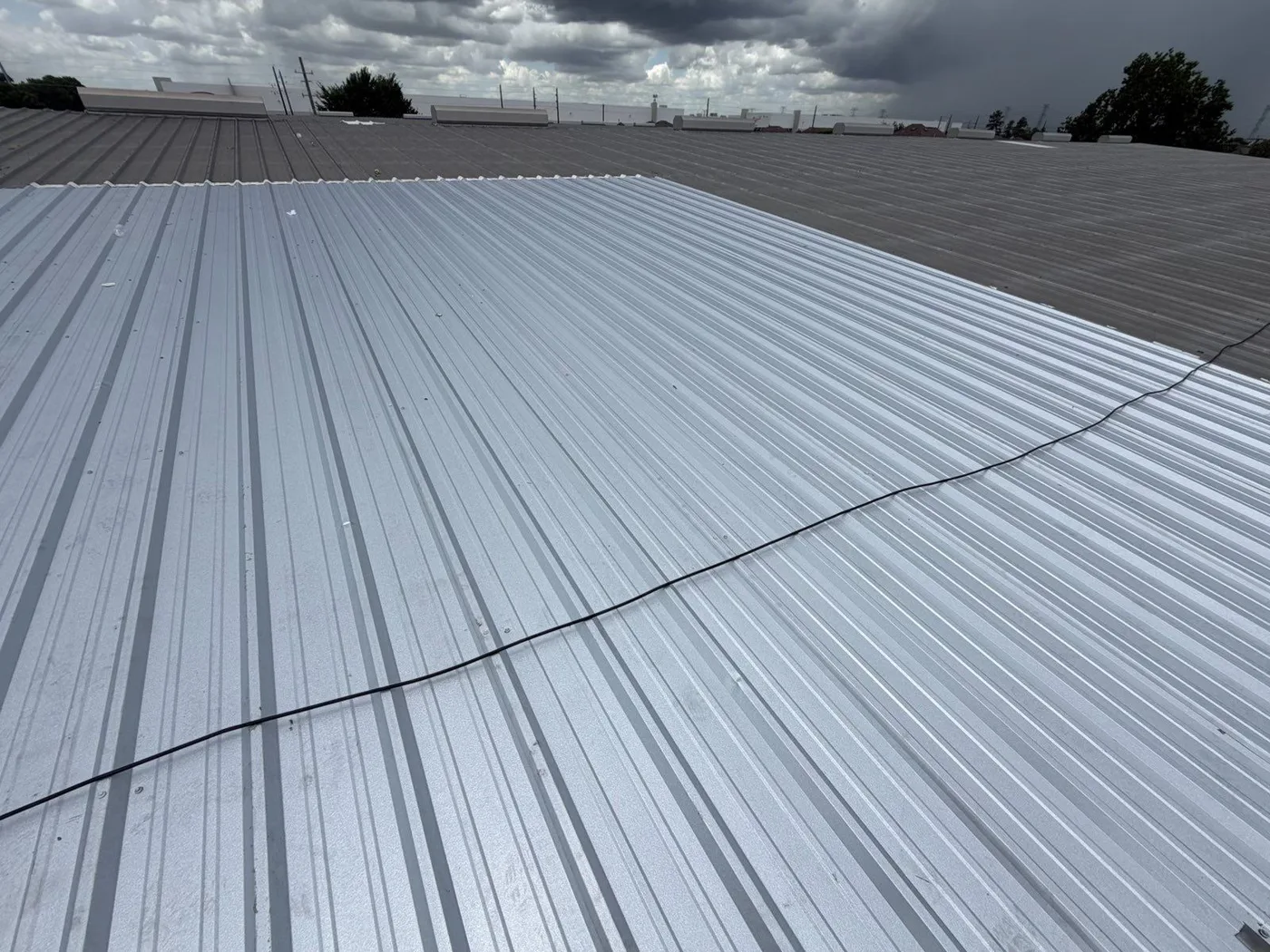
Plenty of Houston industrial roofs wear out on the surface long before the structure under them does. Metal panels with surface rust across the field but solid steel underneath. A modified bitumen roof patched for years. A built-up roof worn bare in the walkways. A roof like that has more options than a tear-off, and on a building this size the gap between them is large.
- Repair
- Fasteners, laps, seams, flashing and panels rusted through, fixed where they failed. It fits a roof whose problems sit in a few places and whose field is sound.
- Metal restoration
- A fluid-applied system over metal panels that are rusted on the surface but still solid: $3.75 to $5.00 a square foot, against $7 to $12 to replace the panels. The system and how it goes on are on our metal roof coating page.
- Membrane restoration
- A fluid-applied system over TPO, PVC, modified bitumen or built-up, where the deck is sound and the insulation dry. It runs $4.50 to $8.00 a square foot, against $15 to $20 to tear off and replace. See commercial roof restoration.
- Metal retrofit
- A new TPO or PVC roof built over the existing metal panels, with nothing torn off. TPO over metal runs $6.50 to $8.00 a square foot and PVC $9 to $12. On sound steel, we generally prefer a retrofit to new panels.
- Tear-off and replacement
- For insulation wet across large areas, or deck that is failing. That is commercial roof replacement.
Which one fits depends on what is under the surface, and that gets checked rather than guessed. A coating over wet insulation or a failing deck hides the problem and wastes the money, and if the checks say so, we tell you.
On a distribution roof, every cent per square foot is multiplied across a very large field. Price more than one of these before deciding.
Buildings in Galveston County, Brazoria County and Harris County east of State Highway 146 have one more thing to raise early. Repairs and re-roofs there can need Texas windstorm certification (WPI-8) for the building to keep its TWIA wind coverage. We do WPI-8 certified work.
05
Maintenance programs for warehouses and distribution buildings
A big industrial roof has a lot of drains, gutters, curbs and flashing to keep track of. A maintenance program puts someone on the roof on a schedule, so a blocked drain or an opening lap gets found before it lets water onto the racking.
Ours run on year-long contracts, with visits twice a year, or four times on roofs that collect more debris. Each visit clears debris and gutters and inspects the flashings and drainage. Repairs come to you as a written proposal rather than being done on the visit. Every visit comes back with before and after photos. Pricing is per square foot, set by access, number of stories and how busy the roof is. The full program is on our commercial roof maintenance page.
For a manager with several buildings in one industrial park, a program covering all of them is priced and scheduled across the buildings together rather than roof by roof. The same visits and the same photos on every roof also make it plain which building needs money this year and which only needs its drains kept clear.

Who you are dealing with
Coons Roofing is a commercial-only roofing contractor working across the Houston metro. It is owned and run by Wade Coons, who is on every project from the first roof walk to the final walkthrough. There is no salesman between you and the person who looked at your roof.
Certified applicator for Versico, FiberTite, Duro-Last, Karnak, IPC, Western Colloid, Elevate and GAF. Fully insured with general liability and workers compensation coverage.
06
Warehouse and industrial roofing FAQs
Can you work on our warehouse roof while the building stays open?
Yes. A repair is local work on part of the roof, and bigger jobs are worked a section at a time so the building keeps shipping. Tell us which bays hold stock that cannot get wet, and when the dock is busiest, before work is scheduled.
Should we coat, retrofit or replace a metal warehouse roof?
It depends on the panels. Surface rust on panels that are still solid points to a coating. A roof that needs a new surface over sound steel points to a TPO or PVC retrofit built over the panels. Panels rusted through across the roof point to replacement, and so does a failing frame, which is a structural problem before it is a roofing one. The cost of each is set out side by side on this page.
How do you know whether an industrial roof can be restored?
On metal, we look at whether the rust has eaten through anywhere and whether any of the roof carries an old coating, because that changes what can go over it. Surface rust on solid panels can be coated; spots rusted through get that section replaced first, and rust-through across the whole roof rules a coating out. On membrane roofs we take core samples, usually two to four, and patch each one immediately, and on larger roofs infrared can show how far wet insulation runs. Wet insulation across large areas, or a failing deck, rules a coating out.
What should we compare when choosing a maintenance program for a warehouse roof?
Compare how often someone is on the roof and what they actually do on each visit. Ask whether repairs are proposed in writing or simply done and billed. Then compare what you get back after each visit and what the price is based on.
Water stands on our warehouse roof for days after rain. Can that be fixed?
Usually. It depends on why the water sits: a blocked drain, crushed insulation, or no way off the roof at that spot. A deck that has sagged between the joists is a structural problem: we document it and quote that repair, or work around it, depending on how severe it is.
Do you install roofs on new warehouse construction?
No. We do no new construction. We repair, maintain, restore, retrofit and replace roofs on existing commercial and industrial buildings.
What if water is coming through the roof onto stock?
Call 713-367-1495. Active water intrusion gets same-day emergency response, including after hours and weekends.
07
Where we work across the metro
We cover Harris, Fort Bend, Montgomery, Galveston, Brazoria, and Waller counties. Pick your city for local detail on what we see on roofs there.

Schedule a free roof assessment
We'll walk your roof, take photos, and give you straight answers. The assessment is free when we are quoting the work.
We reply within 24 hours, usually the same day. No pressure, no sales visit you did not ask for, and we never sell your information.