Commercial flat roof repair in Houston
Commercial flat roof repair in Houston, TX: standing water, blocked drains and scuppers, low spots, worn mod-bit, BUR and TPO roofs. Book a free roof walk.
On this page
01
Commercial flat roof repair in Houston, TX
We handle commercial flat roof repair in Houston, TX and across the metro: water that stands for days, overwhelmed drains and scuppers, and low spots that never dry. We repair worn modified bitumen, built-up, TPO, PVC and coated roofs. That work is on warehouses, distribution centers, light industrial buildings, strip centers, offices, medical offices, churches and apartment properties. Commercial buildings only.
What owners call a flat roof is a low-slope roof, meant to be built with a slight fall toward its drains, scuppers or gutters. Water leaves only where the roof sends it, and only as fast as those openings allow. When that breaks down, the water stays, and nearly every other problem on the roof gets worse.
Two jobs are covered elsewhere. Water dripping into the building right now is a job for commercial roof leak repair, with same-day emergency response, including after hours and weekends. How a split seam, a torn wall flashing or a cracked pipe boot gets fixed on each roof system is on commercial roof repair.
02
Standing water: when it is a problem
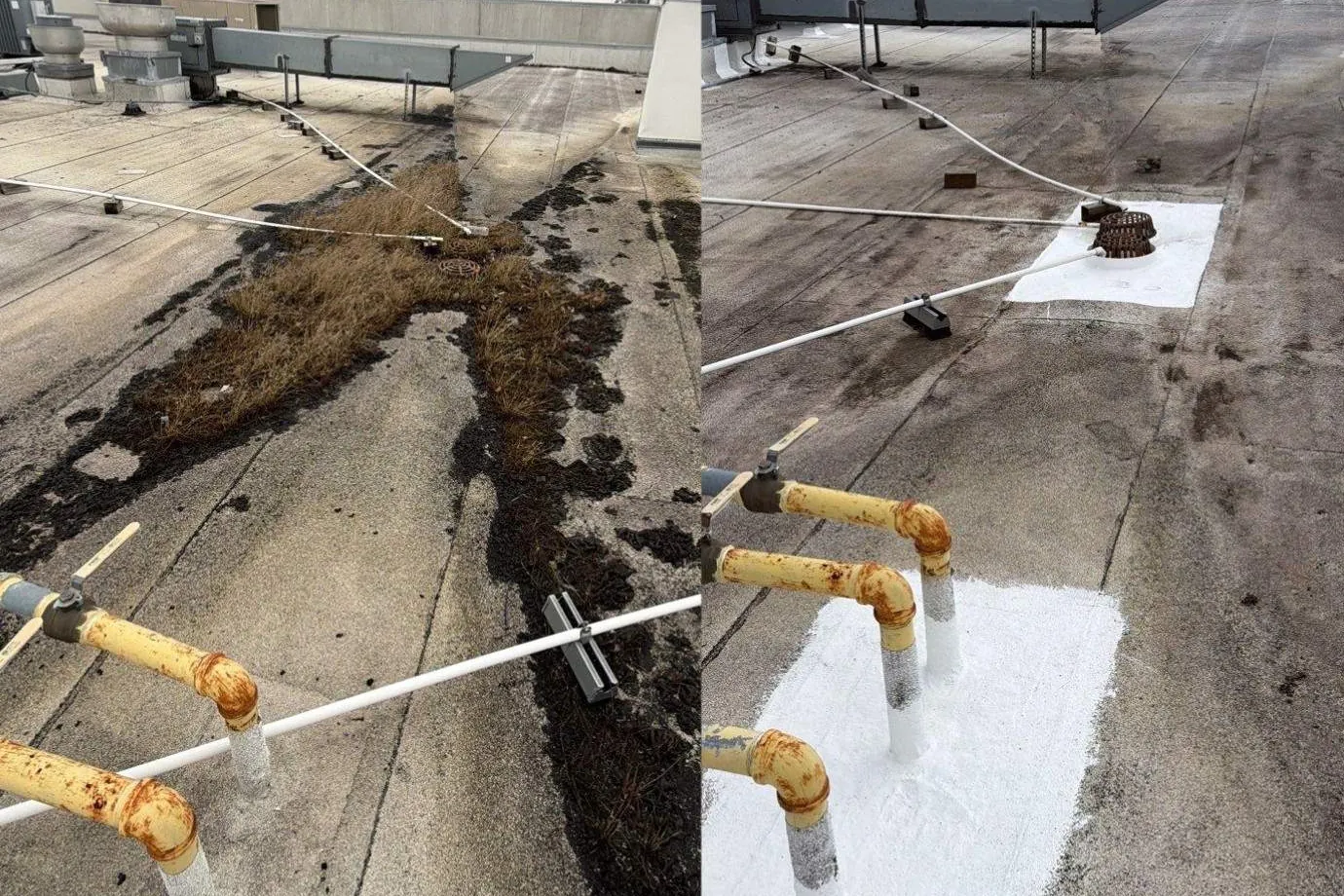
Some water on a flat roof after a storm is normal. Shallow puddles that are gone by the next afternoon are not a repair. What counts is how long the water stays, and where.
The International Building Code, adopted by the City of Houston in its 2021 edition, describes positive roof drainage as a roof built to drain within 48 hours of rain. Water still standing two days after the rain stops is generally treated as ponding. Something about the drainage is not working.
Standing water leaves marks once it dries: a ring of dirt or silt, dark staining or algae, and grass rooted around a drain. On modified bitumen, look for washed-off granules or asphalt cracked into small plates. On a white roof, look for a gray outline that stays after the rest dries.
What standing water does to a flat roof:
Weight. Water weighs a little over 5 pounds per square foot for every inch of depth. On a light steel-framed roof, the weight makes the deck sag, the sag deepens the pond, and the pond adds weight. The building code requires roofs to be designed against this ponding instability (IBC Section 1611).
Wear. Seams, laps and flashing are built to shed water, not sit in it. A small gap in a seam gets a few minutes of water in an ordinary storm. Under a pond, it gets days.
Leaks. A flat roof tends to leak where water sits longest: laps inside a pond, the membrane where it turns down into a drain bowl, and the corners of a scupper. A leak patched without fixing the drainage leaves a new patch in the same pond.
03
What causes ponding on a flat roof
Ponding always has a cause, and the cause decides the fix. Clearing a drain does nothing for a sagging bay. The usual causes, and how each one shows up on the roof:
- Blocked strainer or drain bowl
- Water in a ring around the drain, with leaves, silt or grass packed into the strainer.
- Blocked pipe below the roof
- The drain looks clear, but water backs up around it or drains very slowly. The blockage is in the leader or storm line below the deck, which is a plumber's work.
- A drain sitting high
- A pond around a drain whose rim stands above the roof, often where insulation has crushed down or a newer roof was built up around it.
- Crushed insulation
- Shallow low areas, often soft underfoot, along the paths technicians walk to rooftop units or where materials were stacked.
- Wet insulation
- Soft, spongy areas that hold water, sometimes with blisters. A core cut confirms it. Wet insulation is cut out and replaced, because roofing over it seals the water in.
- Water dammed behind a curb or unit
- A long wet patch on the upslope side of a rooftop unit, skylight or row of equipment supports.
- No fall between drains
- A wet line between two drains, or along a wall between scuppers, where the roof sits level.
- A sagging deck
- Ponds in the middle of bays between columns or joists, often repeating across the roof and deepening year to year. We document it and quote the structural repair it needs, or work around it, depending on how severe it is.
- Too little slope from the start
- Water across broad areas of an older roof built dead level, with nothing wrong at the drains.
- Dams on the roof surface
- Water held back by thick old patches, built-up laps, drifted gravel, pipe supports or an abandoned curb. The obstruction comes out, or the detail is rebuilt flush.
- A scupper missing, too small, too high or blocked
- Water along a parapet wall, a dirt line on the wall, and water spilling where it should not.
Most ponding roofs have more than one of these. A blocked drain surrounded by crushed insulation keeps its pond after it is cleared. So the fix starts with where the water sits and what is under it.
Where the insulation might be wet, core cuts confirm it: small plugs cut down through the roof to show what is under each spot. We usually take two to four, and every hole is patched straight away. On larger projects, an infrared scan shows where the cores should go.
Water still standing on your roof after the rain?
Send the address and describe where the water sits. We walk the roof, photograph the ponds, the drains and the scuppers, and work out what is holding the water there. Then we put the fix and its price in writing before any work starts.
04
Drains, scuppers and overflows
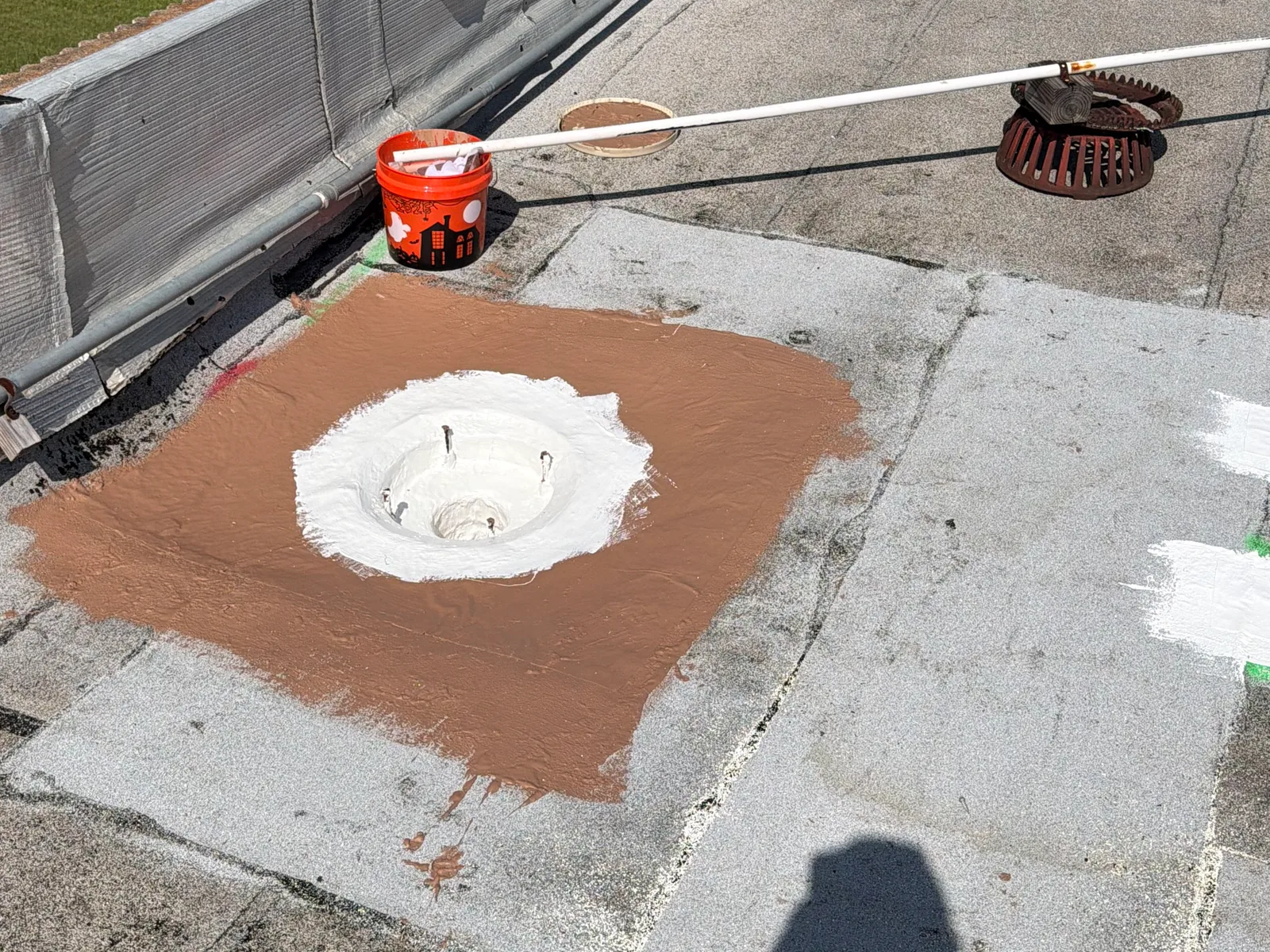
Rain leaves a flat roof through interior drains, through scuppers cut in a parapet wall, or over an open edge into gutters.
A roof drain is more than the dome on top. The drain bowl is set into the deck and joins the pipe below it. The membrane runs down into the bowl and is pinched there by the clamping ring, a heavy ring bolted down over it. The strainer keeps debris out of the pipe.
Drains fail in a handful of ways. Clamping ring bolts work loose and the membrane pulls out from under the ring. The membrane tears where it bends into the bowl. The strainer goes missing and debris goes down the pipe.
Scuppers fail at the wall. The metal liner rusts or comes apart from the roof, the corner flashing splits, or debris piles over the opening. We add scuppers where a roof lacks them and replace or lower failing ones, cutting each in and flashing it. Rebuilding brick or block around it is a mason's job.
Overflows are the backup. The building code calls for overflow drains or scuppers wherever a parapet would trap water if the main drains blocked (IBC Section 1502.2). Houston's plumbing code asks for their water to come out where building staff will see it (UPC Section 1101.12.2). An overflow running in an ordinary rain means a main drain is not keeping up. One patched over or full of debris is no backup at all. On a walled roof with none, we add overflow scuppers.
Most drain trouble starts as debris. Keeping openings clear is what commercial roof maintenance is for, with visits twice a year, or four times on roofs that collect more. What follows is for roofs that still pond with every drain clear.
05
Fixing the drainage: tapered insulation, crickets and drain work
Every drainage fix gets water to an opening faster, or gives it somewhere else to leave.
- Clearing and re-securing a drain
- Debris out, the strainer replaced, clamping ring bolts tightened or replaced, and any tear where the membrane bends into the bowl repaired. The least expensive fix, and the one to rule out first.
- Resetting or relocating a drain
- We reset a high drain so its rim sits below the roof, or build a sump: insulation tapered down so the drain sits in a shallow dip. We also move drains to where the roof actually falls. Moving the pipe below the deck is a plumber's part.
- Rebuilding a low area
- The roof over the low area is opened and crushed or wet insulation comes out. Tapered insulation brings it back into line with the fall, and it is roofed back in with matching material. Walkway pads keep a crushed path from crushing again.
- Crickets and saddles
- Sloped ridges of tapered insulation under the membrane. A cricket turns water around a curb or unit; a saddle splits it between two drains or scuppers. We build both on existing roofs, without a re-roof.
- Tapered insulation across the roof
- Boards with the slope built in, laid out to a drawing so every part of the roof falls toward an opening. It corrects a dead-level roof, usually as part of a re-roof when the roof is open to the deck.
- A new scupper or overflow scupper
- Cut through the parapet and flashed into the roof. A scupper goes in at roof level where the old one is too small, too high or missing. An overflow scupper goes above the main drains.
- A new interior drain
- A plumber runs new pipe down to the storm line, and the roof is opened and closed around the new drain bowl.
Building slope means building height. Tapered insulation and crickets raise the roof surface, so flashing runs higher up walls and some curbs need raising. We raise curbs and lift gas and condensate lines onto new supports. The HVAC contractor disconnects any unit that has to come up.
The code treats new and existing roofs differently. New low-slope membrane roofs need at least a quarter inch per foot of slope (IBC Section 1507). A replaced or recovered roof that drains within 48 hours does not have to meet that, or add overflows. Existing overflows cannot simply be taken out, though (2021 IBC Section 1512 and IEBC Section 705).
Drainage work is priced from the roof: the size of the low areas, the drains and scuppers involved, and what has to be raised or moved. Where tapered insulation is part of it, we have the layout drawn through the manufacturer's design service. The price comes in writing before work begins, and dated before and after photos show what was done.
Which of those fixes does your roof need?
Give us the address and tell us where the water stands. We look at the drains, the scuppers and what is under the ponds, then tell you whether it is a cleared drain, a rebuilt low area or a bigger job.
06
Flat roof systems, by the names owners use
What is actually on the roof, by the name owners use, and how each one takes standing water:
- Mod-bit or torch-down
- Modified bitumen: asphalt-based rolls with a granulated cap sheet, each lapped over the next. Under standing water the granules wash off, the bare asphalt cracks in the sun, and the laps sit wet. Repairs use asphalt-based material.
- Tar and gravel
- A built-up roof: plies of roofing felt mopped with hot asphalt, topped with gravel. Gravel drifts against drains, scuppers and walls, where it holds water, and it hides the roof underneath. We work on gravel-surfaced built-up roofs as well as smooth ones.
- White roof or white single-ply
- Usually TPO or PVC: single-ply sheets with hot-air welded overlaps. Ponds leave a gray ring, and a seam under a pond works hardest. Repairs weld new sheet to old on a clean, dry surface. The membrane itself is on our TPO roofing page.
- Coated roof
- Any of these roofs under a fluid-applied coating. Silicone tolerates standing water, though not its weight or dirt. Acrylics generally do not, and wear through first where water sits. Repairs use a coating that bonds to the one already there.
- A roof with layers
- An older roof with a second roof on top, sometimes a third. Water between the layers can stay there, and every drain has to come up to the new surface. The code does not allow a new roof over two or more existing roofs, or over a water-soaked one (IBC Section 1512).
- Metal building roof
- Standing seam or R-panel metal is a sloped roof that sheds water to its eaves and gutters. Its trouble is at fasteners, laps and rust, covered on our metal roof coating page.
Size changes the stakes. On warehouse and industrial roofing, one blocked drain or one sagging bay can put a great deal of roof under water.
07
When a flat roof is past repairing
Most flat roofs with a drainage problem do not need replacing. A blocked drain, a high drain, a crushed walking path or a missing cricket is repairable when the rest of the roof is sound.
The signs a roof has gone further: ponds across much of the roof, and core cuts away from the low spots finding wet insulation too. A steel deck rusted through or soft under the ponds. Membrane splitting out in the open roof as well as at drains and walls.
Where the insulation is dry and the deck solid but the surface has worn thin, commercial roof restoration is the middle option. The drainage gets fixed first, because a coating over a pond is still a pond. A membrane restoration runs $4.50 to $8.00 per square foot, against $15 to $20 to tear off and replace.
When the insulation is wet across large areas or the deck is failing, commercial roof replacement is the right answer, and tapered insulation can fix the drainage for good.
The photographs and core cuts settle which of those a roof is. When the answer is a cleared drain and a rebuilt low spot, that is the answer you get. Buying a building with a roof that ponds? A commercial roof inspection puts its condition on record before you close.

Who you are dealing with
Coons Roofing is a commercial-only roofing contractor working across the Houston metro. It is owned and run by Wade Coons, who is on every project from the first roof walk to the final walkthrough. There is no salesman between you and the person who looked at your roof.
Certified applicator for Versico, FiberTite, Duro-Last, Karnak, IPC, Western Colloid, Elevate and GAF. Fully insured with general liability and workers compensation coverage.
08
Flat roof repair FAQs
How much does flat roof repair cost in Houston?
A standard commercial roof repair generally runs $1,500 to $3,500: a failed detail at a drain, a scupper, a wall or a seam. Drainage work, like a cricket, a new scupper or a rebuilt low area, is priced from the roof, because it varies too much for one range. Restoring a worn membrane roof runs $4.50 to $8.00 per square foot, against $15 to $20 to replace it. Every price comes in writing after the roof has been walked.
How long should water stand on a flat roof?
No more than about two days. The International Building Code describes a roof with positive drainage as one that drains within 48 hours of rain. Water still standing after that is generally treated as ponding. Shallow puddles that are gone by the next day are normal on a low-slope roof.
Can ponding water be fixed without replacing the roof?
Often, yes. On an existing roof we clear drains and re-secure clamping rings, reset or relocate high drains, and add scuppers and overflow scuppers. We also rebuild low areas with new insulation and build crickets and saddles. A roof that is level across its whole area is usually best re-sloped when it is replaced.
What is the best material for a flat roof repair?
The same material the roof is made of. A TPO roof takes TPO welded to it, PVC takes PVC, and modified bitumen and built-up roofs take asphalt-based material. A coated roof takes a coating that bonds to the one already there, which on silicone means more silicone. Roof cement and tape stop water for a while, but they do not bond to TPO, and asphalt products damage PVC. Treat them as temporary.
Why does my flat roof keep leaking?
Usually because the repair went on the wrong spot, in the wrong material, or on a detail that still sits in water. A patch in a pond is up against the same water every rain. If it is leaking now, deal with it as a leak call first. Once the roof is dry, find out why water stands there and fix that along with the detail.
Is standing water dangerous for the roof structure?
It can be. On a deck that flexes, the weight of the water makes the deck sag, which deepens the pond. A deck that visibly sags, or a ceiling bowing below a ponded area, needs people kept clear of it. We document a sagging deck, then quote the structural repair or work around it, depending on how severe it is.
What flat roofs do you repair, and where?
Modified bitumen, built-up with or without gravel, TPO, PVC and coated roofs on commercial buildings: warehouses and distribution centers, industrial buildings, strip centers, offices, medical offices, churches and apartment properties. No houses. We cover Houston, TX and its metro across Harris, Fort Bend, Montgomery, Galveston, Brazoria and Waller counties. Repairs in Galveston County, Brazoria County and Harris County east of State Highway 146 can need Texas windstorm certification (WPI-8), and we do WPI-8 certified work. Form inquiries get a reply within 24 hours, usually the same day.

Have a flat roof that never quite dries out?
Give us the building, a rough roof size and where the water collects. Once the roof has been walked and photographed, we explain what keeps the water there, what fixing it involves, and send the price in writing.
09
Where we work across the metro
We cover Harris, Fort Bend, Montgomery, Galveston, Brazoria, and Waller counties. Pick your city for local detail on what we see on roofs there.
Related services

Schedule a free roof assessment
We'll walk your roof, take photos, and give you straight answers. The assessment is free when we are quoting the work.
We reply within 24 hours, usually the same day. No pressure, no sales visit you did not ask for, and we never sell your information.