Commercial TPO roofing contractor in Houston
TPO roofing in Houston, TX from a commercial TPO roofer: new roofs priced per roof, and TPO over metal at $6.50 to $8.00 a sq ft. Book a free roof walk.
On this page
01
Commercial TPO roofing in Houston, TX
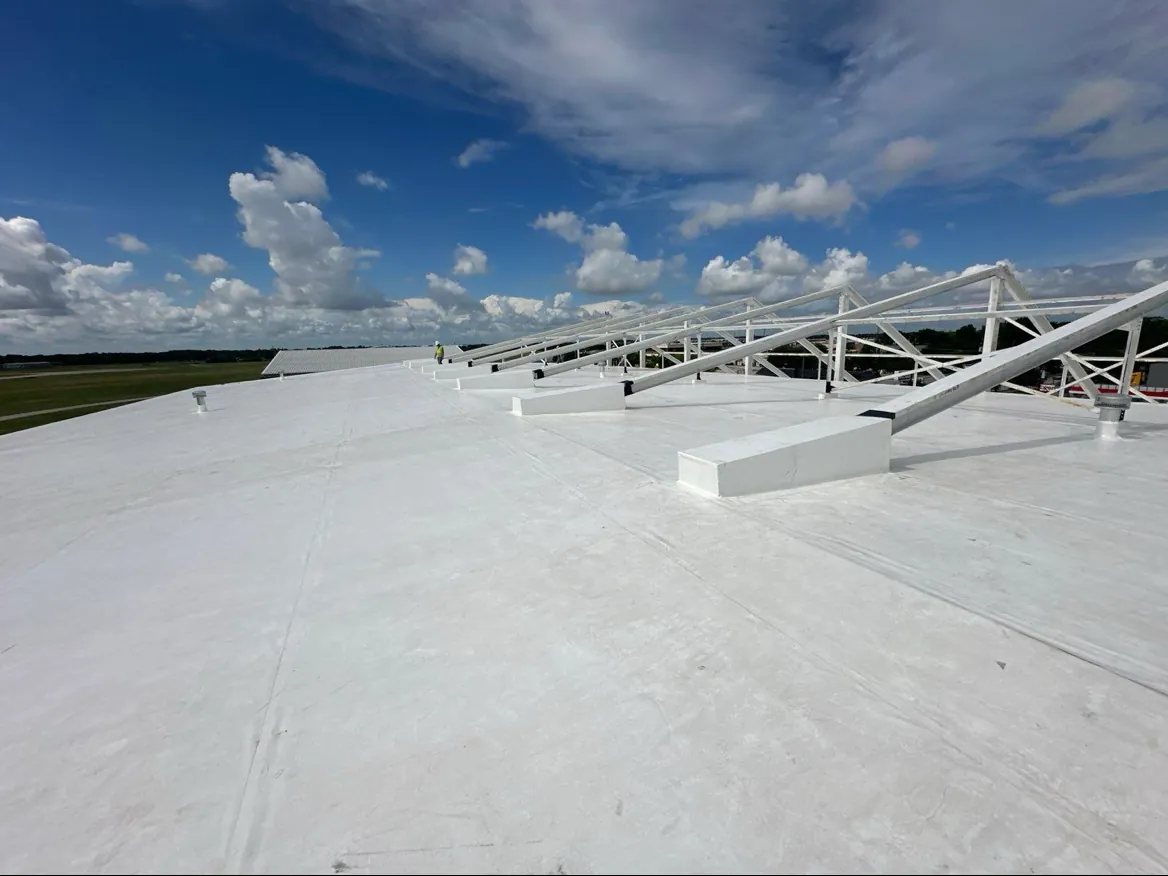
We are a commercial TPO roofing contractor in Houston, TX. We handle TPO installation and replacement, build TPO roofs over existing metal ones, and look after TPO roofs already up there. That work is on warehouses, distribution centers, strip centers, offices and churches across the metro. If you are looking for a TPO roofer, this page covers how the work is done, what it costs and what to get in writing.
TPO, short for thermoplastic polyolefin, is a single-ply membrane for flat and low-slope roofs, usually white: a plastic sheet with reinforcing fabric through the middle. The sheets overlap at their edges, and every overlap is welded with hot air so two sheets become one. That puts it in the same family as PVC. EPDM, the black rubber membrane, has taped and glued seams instead.
In Houston it is common on distribution and light industrial buildings along the Ship Channel and out toward the Grand Parkway, and on big-box retail, medical offices and office buildings. Its white surface throws back much of the sun, for as long as it is kept reasonably clean.
It has limits. Over a restaurant exhaust fan the membrane should be PVC, and like any single-ply sheet, TPO can be punctured by dropped tools, storm debris and service crews.
If water is coming into the building today, start with commercial roof leak repair instead, with same-day emergency response.
02
How a TPO roof is built
The white sheet is only the top layer. From the deck up:
The deck. Usually steel on warehouses and industrial buildings, sometimes wood or concrete. On a retrofit it is the old metal panels, with the fastening carried through them into the steel framing below.
The insulation and, where the system calls for one, a cover board directly under the sheet. Cover board does the most work when the membrane is glued down to it.
The membrane. The TPO sheet is made to a published standard, ASTM D6878, most commonly in 45, 60 and 80 mil. A mil is a thousandth of an inch, and a thicker sheet has more weathering layer above the fabric.
The details. Walls, curbs, pipes, drains and the roof edge, where most of the labor goes and most leaks start. Pipes get pre-formed boots and corners get pre-formed pieces. The edge commonly gets sheet metal coated with TPO, so the membrane welds straight to it.
Manufacturers generally tie their longer warranty options to thicker sheet. Thickness does not make up for poor welds, standing water or bad details, and it belongs in the proposal. On most of our TPO roofs, that is 60 mil.
03
How TPO is held down: fastened, adhered or induction-welded
On the Gulf Coast the sheet has to be held against real wind. There are three common ways to do it.
- Mechanically attached
- Screws and round plates go through the edge of each sheet into the deck, and the next sheet laps over them and is welded down. Usually the quickest and least expensive method on a steel deck. Between fastener rows the sheet can flutter in strong wind, so the wind design sets the row spacing.
- Fully adhered
- The sheet is glued down across its whole back, so it lies flat and nothing flutters. It costs more, needs dry weather, and some adhesives smell strongly while they cure. Shutting down or covering any rooftop air intake near the work is the building owner's responsibility, arranged before the work starts.
- Induction-welded plates
- Plates are fastened down first and the sheet is laid over them. A tool heats each plate from above to bond it to the underside of the membrane, so no fastener goes through the sheet.
The choice comes from the deck, the building's height and wind exposure, whether it is occupied, and what the warranty calls for. On a tight budget or an unoccupied building, we reach for mechanically fastened first, because it goes down fast. We fully adhere on concrete decks, on overlays of occupied buildings where noise is a concern, or to meet higher uplift requirements. Induction-welded plates go on metal retrofits, extra-wide rolls on big open roofs, or again for uplift. On warehouse and industrial roofing, where one roof can run for acres, attachment moves the price and schedule as much as the membrane does.
04
The seams: welded with hot air
The weld is what makes TPO work. Hot air melts the top of one sheet and the underside of the sheet lapped over it, and a roller presses them together. Once cool, the two sheets are one piece, with no glue to dry out and no tape to let go.
Long field seams are welded with an automatic welder running down the lap at a set heat and speed. At curbs, pipes, corners and walls, a roofer uses a hand-held welder and a small roller. Either way the lap has to be clean and dry.
A weld cannot be judged by eye. Test welds are cut and peeled by hand at the start of the day and whenever the weather or sheet changes; a good one will not peel open. Once seams cool, a probe runs along every seam edge to find gaps and skips. On a new TPO roof we probe every single seam, with test welds through the day.
The faults that become leaks are specific. A cold weld looks fine and peels open later. A burned weld scorches and weakens the sheet. A fishmouth, a small open wrinkle at the lap edge, channels water under the seam. Where three sheets meet at a T-joint, manufacturers commonly call for a patch on thicker sheet.
05
TPO vs PVC
PVC is TPO's closest relative: a white, fabric-reinforced single-ply sheet, welded with hot air, held down the same ways, and hard to tell apart by eye. One difference settles the question.
- Grease and cooking oil
- The one that settles it. Grease from restaurant exhaust fans lands on the roof around the fan, and TPO goes soft and wears through to the fabric. PVC holds up to grease far better, so a PVC-type membrane rated for grease belongs over commercial kitchens. Wade's note on a photograph of one of those roofs reads, in full: “Failed TPO over restaurant. Needs PVC to withstand grease.”
- Other chemicals
- Neither sheet resists everything. Where process exhaust lands on a roof, the manufacturer's chemical resistance data gets checked against what actually lands there.
- Cost
- TPO generally costs less, so most of the single-ply we install is TPO. Our retrofit prices show the gap: TPO over an existing metal roof runs $6.50 to $8.00 per square foot, and PVC $9 to $12. Where a roof needs a grease-resistant membrane, FiberTite is the one we install most.
- Welding and repair
- Both weld, but not to each other. TPO is repaired with TPO and PVC with PVC, so any repair starts by knowing which one is on the roof.
- Where each fits
- TPO: most warehouses, distribution centers, offices and retail roofs. PVC: roofs over restaurants and commercial kitchens, food processing, and buildings whose exhaust puts oil or chemicals on the roof.
A strip center can have one restaurant among a dozen suites, and the roof around that one exhaust fan is where the membrane decision gets made. Retail and strip center roofing covers the rest of what a multi-tenant roof brings. Keeping grease in the fan is a job for the kitchen exhaust contractor.
Once grease has worn out a TPO roof, the answer is a re-roof in a PVC-type membrane. TPO and PVC cannot be welded together, so PVC does not get patched into a worn TPO roof.
Not sure whether your building needs TPO or PVC?
Tell us what the building is and what sits on the roof: restaurant exhaust, process vents, a lot of equipment. We will look at the roof itself and explain which membrane fits it, and why.
06
TPO installation and replacement
A new TPO roof goes on after a tear-off down to the deck, or as a recover over an existing roof that is still a sound, dry base. Which of those fits, and what a replacement proposal should name, is on our commercial roof replacement page.
Two TPO roofs of the same brand and thickness mostly differ in details a bid can leave out. Whichever TPO roofing contractor or installer you hire, get these TPO details in writing.
- Flashings and edges
- Pre-formed boots and corners where they fit, and TPO-coated edge metal, so the membrane welds straight to it.
- Drains
- Each drain reset with its clamping ring, so the membrane is clamped into the drain bowl rather than lapped over the opening.
- Walkway pads
- Welded along the paths crews walk to rooftop units, so the same route does not wear the sheet thin. On our new roofs they are standard.
Over an occupied building, the old roof comes off a section at a time, and each day's section is closed back up before the crew leaves it.
We are certified applicators for Versico, FiberTite, Duro-Last, GAF and Elevate membrane systems. Approval is generally a condition of a manufacturer's system warranty, not a guarantee of one: the manufacturer decides whether a roof qualifies.
In Harris County east of State Highway 146, and in Galveston and Brazoria counties, a TPO re-roof or repair can need Texas windstorm certification (WPI-8) for TWIA wind coverage. We do WPI-8 certified work.
07
TPO over an existing metal roof
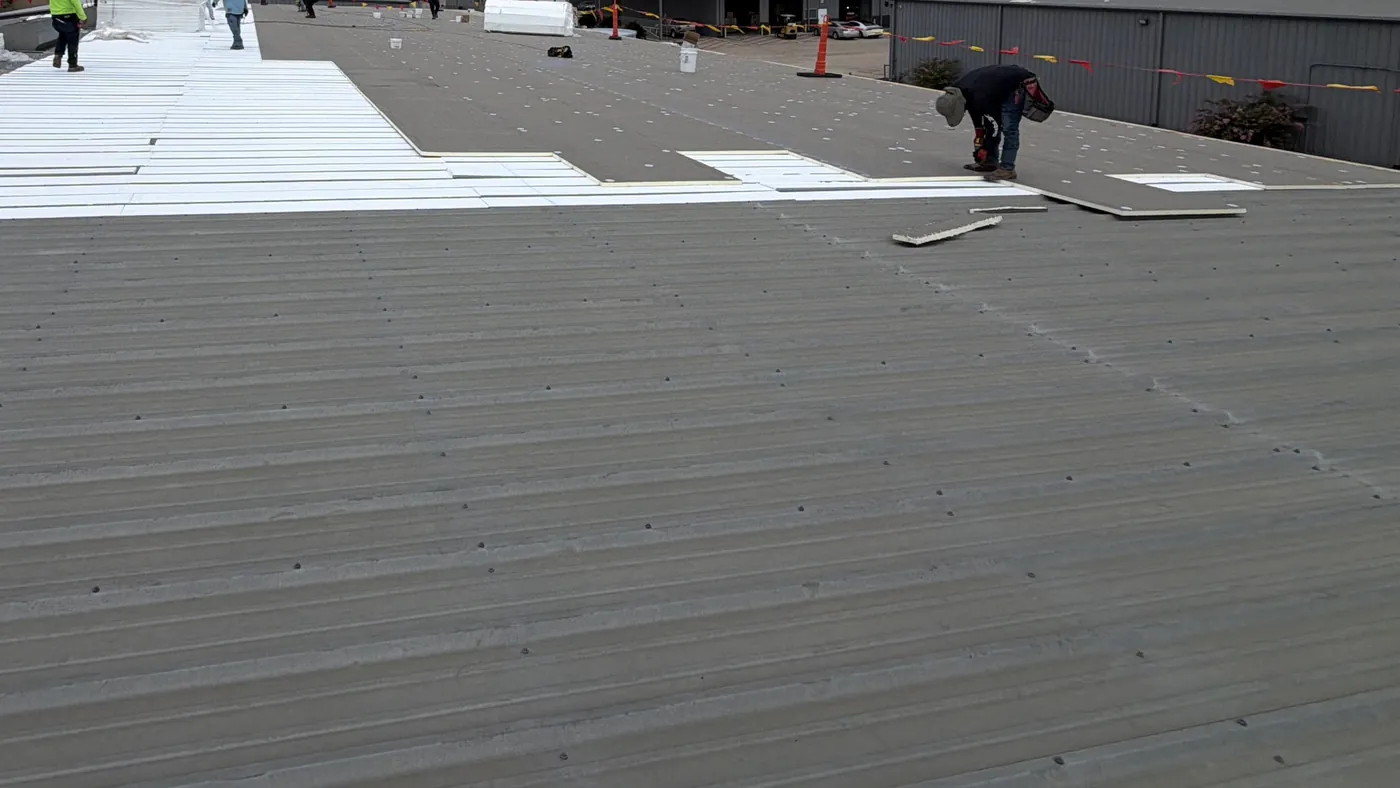
Where a metal building still has good panels and good framing, a TPO retrofit builds the new roof over the old metal. The panels never come off, and a ribbed metal roof becomes a smooth, welded membrane roof.
Foam cut to the panel's shape fills the low channels between the ribs, and insulation or board is laid over the foam. The TPO is attached through the old panels into the purlins, the steel framing the panels are fastened to. It is held with screws and plates in the laps or with induction-welded plates.
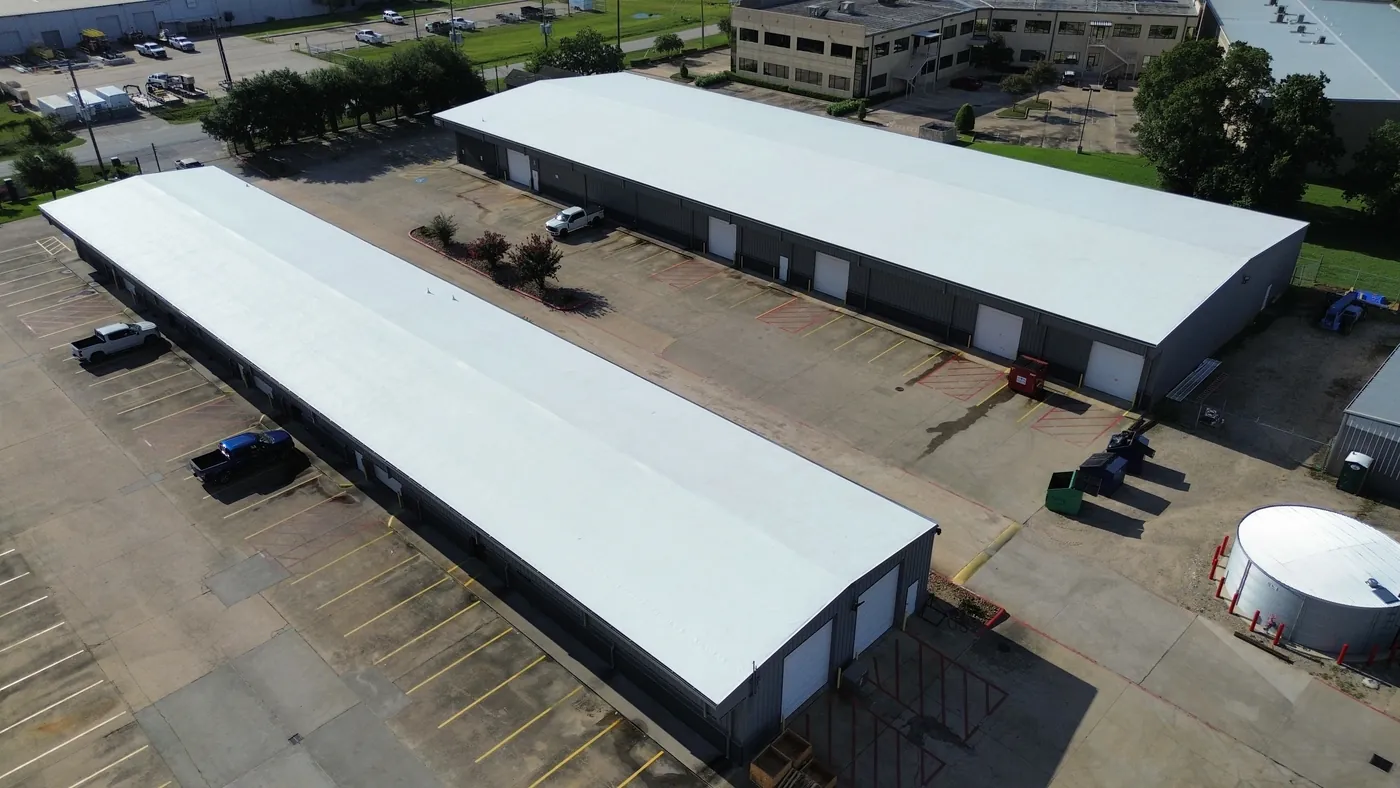
Whether a metal roof should be retrofitted, coated or repaired, and what each costs, is on our metal roof coating page.
08
What wears out on a TPO roof
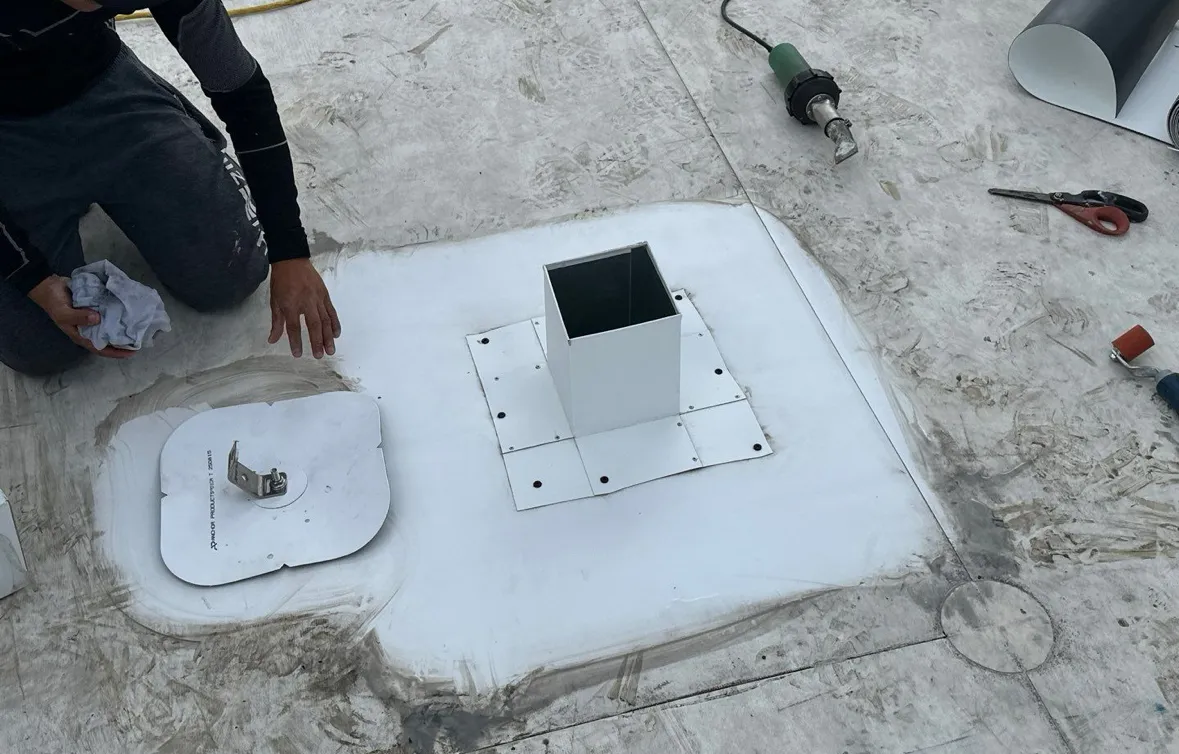
On most TPO roofs, the first trouble is at the details, not the open sheet: cold or worked-open seams, split pipe boots, and flashing pulling away at curbs and walls. Then come punctures along service paths. Water in at any of them can wet the insulation well before a stain shows inside.
Most of it is repairable with new TPO welded to the old sheet. How a TPO repair is found, done and priced is in our guide to TPO roof repair in Houston. For modified bitumen, built-up and metal roofs, see commercial roof repair. Water coming through a ceiling right now is a phone call: 713-367-1495.
09
Restoring an aging TPO roof, and what each option costs
Between a repair and a new roof sits restoration, for TPO weathered across the field with seams and flashings failing in more than a few places. If the insulation is dry and the deck solid, a fluid-applied coating system can go over the existing sheet instead of a tear-off.
Coatings do not bond well to TPO without preparation: cleaning, seam and flashing repairs, and the coating manufacturer's single-ply system, generally with a primer and an adhesion test. The systems are on our commercial roof restoration page.
Which answer a roof gets is decided under the sheet. A core sample is a small cut down to the deck showing whether the insulation is wet and how many roofs are there. We usually take two to four and patch each one as soon as it is cut. On larger projects, infrared helps show where wet insulation is likely in between.
- Damage in a few places, the rest sound
- Repair. A standard repair generally runs $1,500 to $3,500.
- Weathered everywhere, insulation dry, deck solid
- Restoration. A membrane restoration runs $4.50 to $8.00 per square foot, with no tear-off.
- Insulation wet across much of the roof, a deck giving way, or sheet splitting in the open field
- Tear-off and replacement, at $15 to $20 per square foot for a membrane roof.
- A metal roof past repairing, on sound steel
- Retrofit. $6.50 to $8.00 per square foot for TPO over the metal, or $9 to $12 for PVC.
- New TPO over a sound existing roof
- Priced per roof. Thickness, attachment, insulation and details move it too far for one published range to mean anything.
The ranges are for the Houston market, and every number comes in writing after the roof has been walked. Size, curbs, pipes, drains and walls, the sheet and attachment, wet insulation and access move a job within its range. All of our prices are side by side in the commercial roof cost guide.
Which of those rows is your TPO roof?
Give us the address and a rough size. We walk the roof, cut core samples where the insulation is in question, and put a written price on each option that is genuinely open to you.
10
How long a TPO roof lasts, and what the warranty covers
No single number of years fits every TPO roof. Two roofs installed the same year can be in very different shape a decade later, and the reasons are mostly visible.
Cold welds open at the seams long before the sheet is worn. A sheet that flutters in every storm works its fasteners and seams harder than one held flat. TPO wears faster where water stands for days; ponding and its fixes are on our flat roof repair page. Unpadded service paths and dropped screws puncture the sheet, and grease can finish one part of a roof early.
Upkeep counts too: drains kept clear, debris off, small openings fixed while small, the work commercial roof maintenance exists to do. For a dated record of where a roof stands before a purchase or a budget, book a commercial roof inspection.
On the TPO roofs we install, the usual arrangement is a 20-year full-system manufacturer warranty, where the roof qualifies. It covers material and labor with no dollar limit on repairs, and our own 2-year workmanship warranty sits on top. A warranty says what the manufacturer will pay for, on its terms. It is not a forecast of how long the roof will last.
On a roof that already has a warranty, read the exclusions before anyone cuts into it, even for a core sample.
Who you are dealing with
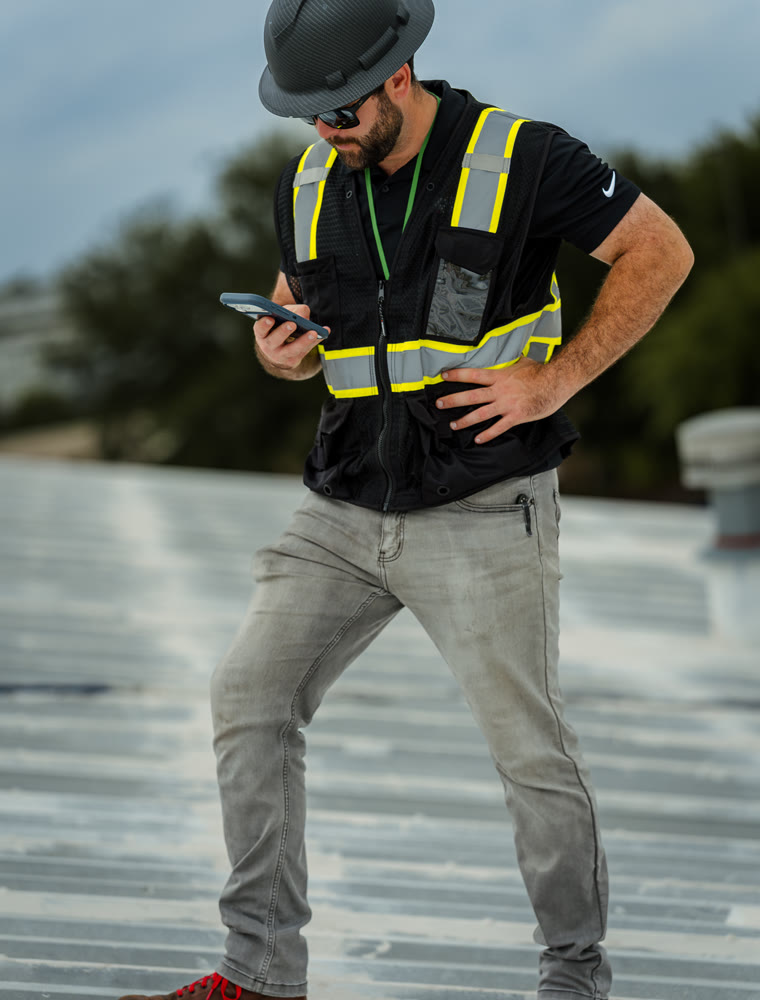
Coons Roofing is a commercial-only roofing contractor working across the Houston metro. It is owned and run by Wade Coons, who is on every project from the first roof walk to the final walkthrough. There is no salesman between you and the person who looked at your roof.
Certified applicator for Versico, FiberTite, Duro-Last, Karnak, IPC, Western Colloid, Elevate and GAF. Fully insured with general liability and workers compensation coverage.
11
TPO roofing FAQs
What is TPO roofing?
TPO, short for thermoplastic polyolefin, is a single-ply membrane, usually white, for flat and low-slope commercial roofs. It is a plastic sheet with reinforcing fabric inside, laid in wide rolls with the overlapping edges welded together with hot air. It is common on warehouses, distribution centers, retail and office buildings.
How much does TPO roofing cost in Houston?
A TPO retrofit over a metal roof runs $6.50 to $8.00 per square foot, and PVC $9 to $12. Restoring a weathered membrane roof runs $4.50 to $8.00 per square foot, against $15 to $20 to tear it off and replace it. New TPO over a sound roof is priced per roof. A standard repair generally runs $1,500 to $3,500. Nothing is priced until the roof has been walked, and then the price comes in writing.
TPO vs PVC: which is better?
Neither is better on every building. For most warehouses, offices and retail roofs, TPO does the job for less money. PVC holds up to grease and cooking oil far better, so it belongs over restaurants and commercial kitchens. Both are welded with hot air, but not to each other, so a repair must match the roof.
How long does a TPO roof last?
No single number fits every roof. It comes down to the sheet thickness, the quality of the welds, how the sheet is attached, and whether water stands on it. Foot traffic, debris, grease, chemicals and upkeep of the drains and details all play a part. A warranty term is not a lifespan: it is what the manufacturer will cover, on its terms.
How do I choose a TPO roofing contractor in Houston?
Ask which manufacturer's TPO system they will install, and whether that manufacturer has approved them to install it, since a system warranty generally depends on it. Get the sheet and its thickness, the attachment method, the flashing and drain details, and how seams are tested in writing, with the price. And ask for the roof to be walked and photographed before the proposal. Our own certifications cover Versico, FiberTite, Duro-Last, GAF and Elevate membrane systems.
Can you coat a TPO roof?
Often, if the insulation under it is dry and the deck is sound. The roof is cleaned, seams and flashings are repaired, and the coating manufacturer's single-ply system is followed, generally with a primer and an adhesion test. A membrane restoration runs $4.50 to $8.00 per square foot. On a roof still under warranty, check the terms first.
Where do you install TPO roofs?
On commercial buildings across Houston, TX and its metro: Harris, Fort Bend, Montgomery, Galveston, Brazoria and Waller counties. That runs from Conroe and The Woodlands in the north to Galveston in the south, Katy in the west and the Ship Channel in the east. We do not work on houses. Send the form and you get a reply within 24 hours, usually the same day.

Have a TPO roof you are not sure about?
Send the building, the roof's age if you know it, and what you have noticed up there. After a walk and photographs, you hear whether it needs a repair, a restoration, or nothing yet.
12
Where we work across the metro
We cover Harris, Fort Bend, Montgomery, Galveston, Brazoria, and Waller counties. Pick your city for local detail on what we see on roofs there.
Related services

Schedule a free roof assessment
We'll walk your roof, take photos, and give you straight answers. The assessment is free when we are quoting the work.
We reply within 24 hours, usually the same day. No pressure, no sales visit you did not ask for, and we never sell your information.