Commercial roof leak repair & emergency response in Houston
Commercial roof leak repair in Houston, TX. Same-day emergency response for active leaks, temporary protection, and leak detection. Call 713-367-1495.
On this page
01
What to do in the first hour
If water is coming through the ceiling of a commercial building right now, call or text 713-367-1495. Active water intrusion gets same-day emergency response, including after hours and weekends. A standard leak repair generally runs $1,500 to $3,500, priced in writing before the permanent work starts.
We handle commercial roof leak repair and emergency roof repair on warehouses, retail, offices, medical buildings, churches and apartment properties across Houston, TX and the metro. Commercial buildings only.
While you wait, do this.
- Keep people clear
- Keep everyone away from a ceiling that is sagging or holding water, and from water near lights or electrical panels. Water near electrical is for an electrician or your building engineer.
- Protect what is underneath
- Where it is safe, move inventory, files and computers out from under the wet area. Cover what cannot move with plastic sheeting, and put buckets under the drip.
- Photograph it
- Photos and a short video of the ceiling, the drip and whatever it has hit, with the date and time on them.
- Note when it leaks
- Only while it rains, hours after the rain stops, or when the air conditioning runs. That one detail often tells us more than the stain does.
- Stay off the roof
- Do not send staff up a ladder in the rain. A wet roof is slick, and walking a damaged roof can make it worse.
- Sort out roof access
- Who has the hatch key, where the ladder goes up, and whether a tenant space or alarm code is in the way. Access is often what slows a response down.
Soaked carpet, drywall and ceiling tile, or any smell of mold, are work for a water cleanup company. We stop the water at the roof.
02
How our emergency response works
Call or text 713-367-1495. Office hours are Monday through Friday, 7am to 5pm, and a leak does not have to wait for them. The contact form is for anything that is not leaking. It gets a reply within 24 hours, usually the same day.
When you call, we ask for the address, where the water shows inside and how we get onto the roof. A photo of the ceiling sent by text helps.
On the roof, the emergency visit has three jobs. Find where the water is most likely getting in. Stop it for now. Photograph all of it, with a date on every photo.
Temporary protection is whatever the failure calls for: patches, tarps or sheeting. On TPO or PVC, that can be a compatible sealant or patch; on modified bitumen or built-up, roof cement and fabric made to go on wet. A torn section gets sheeted and weighted against the wind, and a choked drain gets cleared.
Temporary materials are right for a storm and wrong to leave in place. Every one gets photographed, and the report says what should replace it. When a storm opens more roof than we can cover at once, protection goes first over occupied space, inventory and electrical rooms. On a clinic, that means procedure rooms, as medical office roofing explains.
Wade's reason for keeping the company built the way it is: “With us, the person who looks at the roof is tied to the fix. We move faster, communicate cleaner, and tell you when you do not need to spend money.”
Water coming in right now?
Call or text with the address and where the water is showing inside. Active water intrusion gets same-day emergency response: find where it is most likely getting in, stop it for now, photograph it.
03
Finding where the water actually gets in
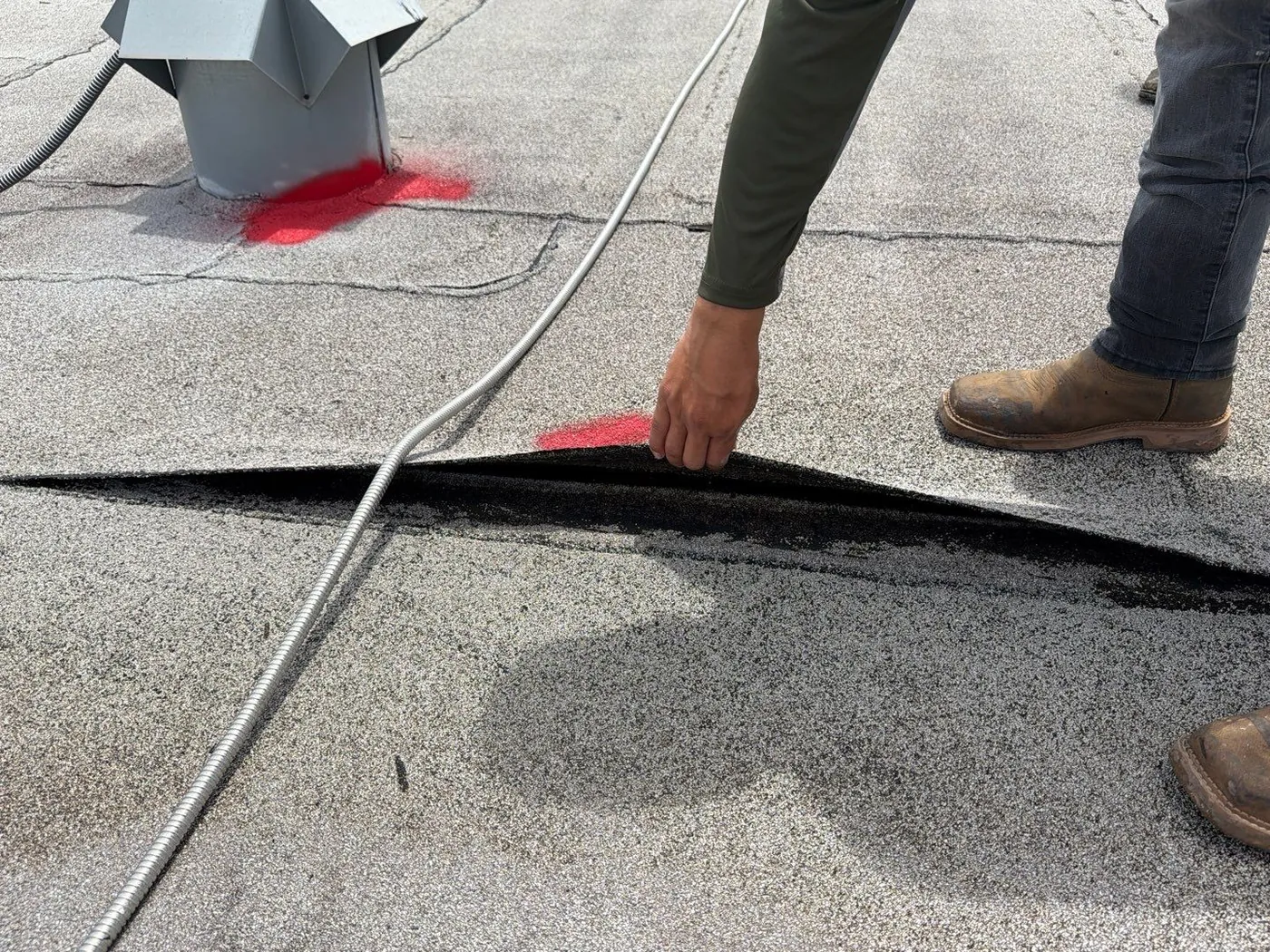
On a low-slope commercial roof, the stain on the ceiling is where the water ended up, and often not where it got in. That is how leaks get patched in the wrong place.
Water gets in at a seam, a flashing, a curb, a pipe or a fastener. It runs along the insulation or the flutes of a steel deck and drops through at the first gap. On a large warehouse that can be a long way from the opening, which warehouse and industrial roofing covers. In a strip center, the wet suite can sit next door to the failure, as retail and strip center roofing explains.
So we place the stain from above and walk every detail around it, upslope first, including every old patch. A core cut shows whether the insulation around the leak is wet, and a few show roughly how far it has spread.
What you noticed inside narrows it down.
- Near an outside wall
- Often the base flashing, the counterflashing above it, or the joints in the coping. Cracked brick above the roof line is a mason's job.
- Under or beside a rooftop unit
- Often the curb flashing, especially at the corners. Condensate from the unit belongs to your HVAC contractor.
- Mid-room, at a light or sprinkler pipe
- Usually traveled there from a seam, pipe, exhaust fan or skylight somewhere else on the roof.
- Near a roof drain or a column
- Often a loose clamping ring or water backed up behind a blocked strainer. A leaking drain pipe below the deck is a plumber's work.
- Only in wind-driven rain
- Points at the edges: edge metal, coping, counterflashing, and on metal roofs the ridge, trim and laps. It can also be a wall or window above the roof line.
- Hours after the rain stops
- Water is held somewhere and let out slowly: wet insulation, a blocked drain, or a low area holding water against a seam.
Where a walk and core cuts are not enough, infrared on larger roofs or a controlled water test can narrow it down. When a leak is hard to pin down, we say so, and say what comes next.
04
How leaks start on each roof system
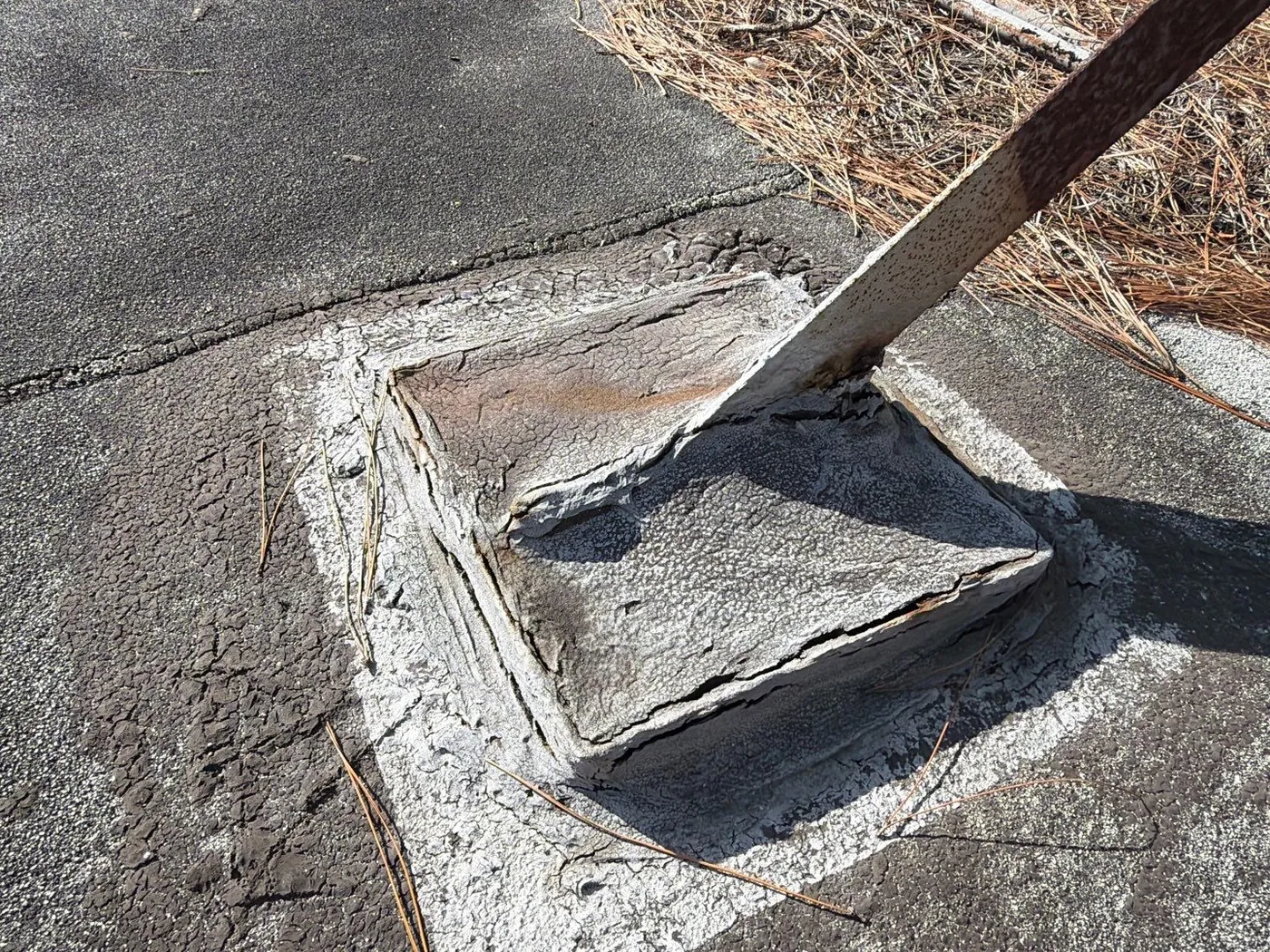
Each commercial roof system leaks at its own weak points. These are the places we look first.
- TPO and PVC
- Seams that opened or were never fully welded, curb corners, pipe boots, and punctures where crews walk. More on TPO roofing.
- Modified bitumen
- Base flashing on walls and curbs, laps, blisters, and cracks where the granules have worn away.
- Built-up and gravel
- Drains, pitch pockets, walls and old patching, often hidden under gravel. Water can run between the plies a long way.
- Metal
- Backed-out fasteners, worn washers and laps on R-panel; seams, ridge and trim on standing seam. Condensation off bare panels after a cool night looks like a leak and is not one. Where rust has spread, see metal roof coating.
- Coated roofs
- Water travels through the roof underneath. The repair has to match the coating already there, so we identify it first.
Water that stands for days after rain is not a leak by itself, but it works into any open seam. Ponding and drainage are on our flat roof repair page.
A leak that keeps coming back?
Tell us the building, where the water shows up and what has been done about it so far. We walk the whole roof, look under the old patches, photograph what we find, and tell you where we believe the water is getting in, and what comes next.
05
Storm, hail and wind: response and documentation
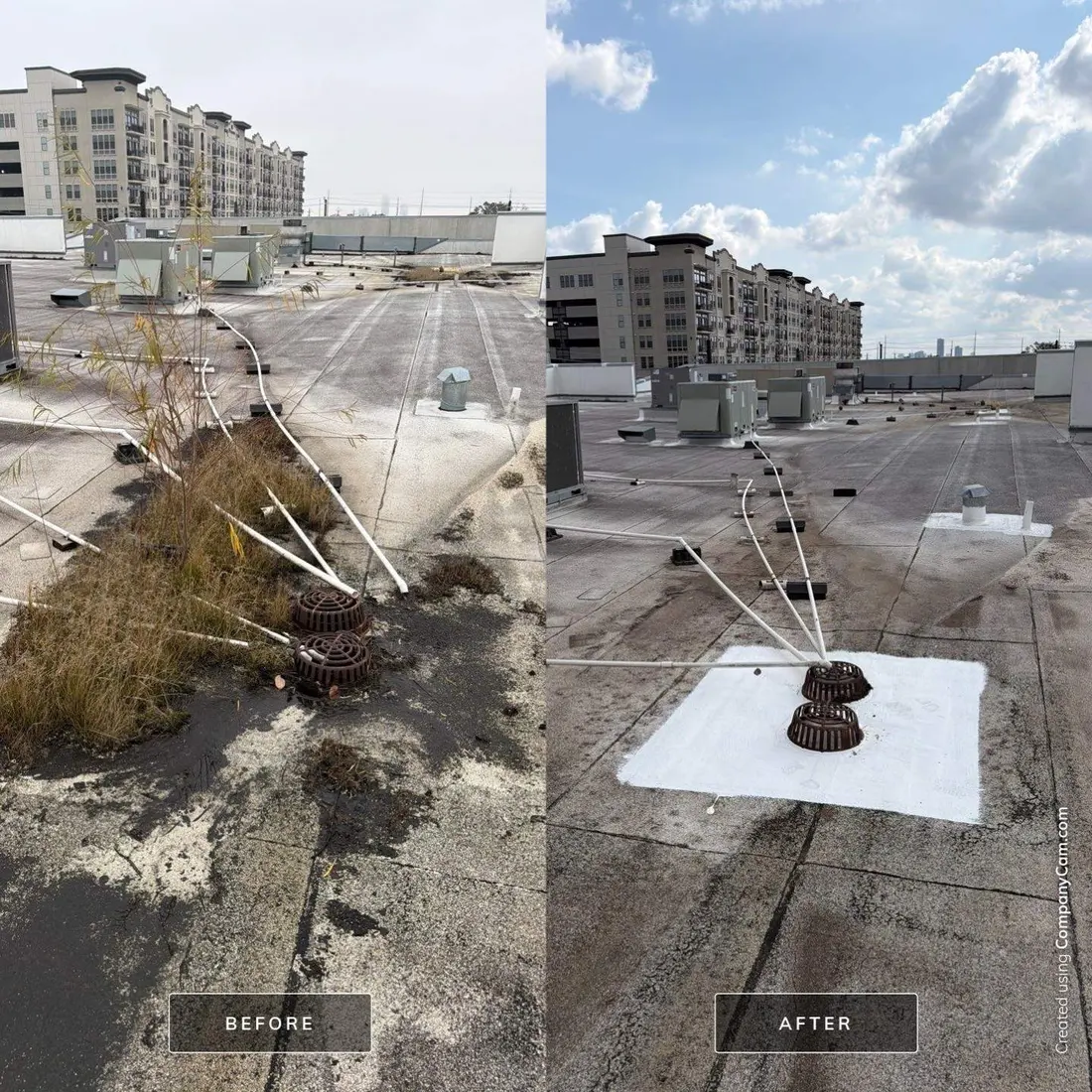
Wind works under edge metal and roof corners. Hail can bruise membrane and dent metal panels without leaving a hole anyone can see.
The order is the same as any leak: stop the water, then find out what else the storm did. We walk all of the roof, including sections nowhere near the wet ceiling, and clear debris from the drains.
Every photo carries its date: the entry points, the temporary protection and the damage across the rest of the roof. The report is laid out to forward without rewriting, to ownership or your management company.
If a storm has come through and nothing is leaking, that is not an emergency call. Book a commercial roof inspection and the roof's post-storm condition goes on record with dates.
06
Commercial roof leak repair: the permanent fix and what it costs
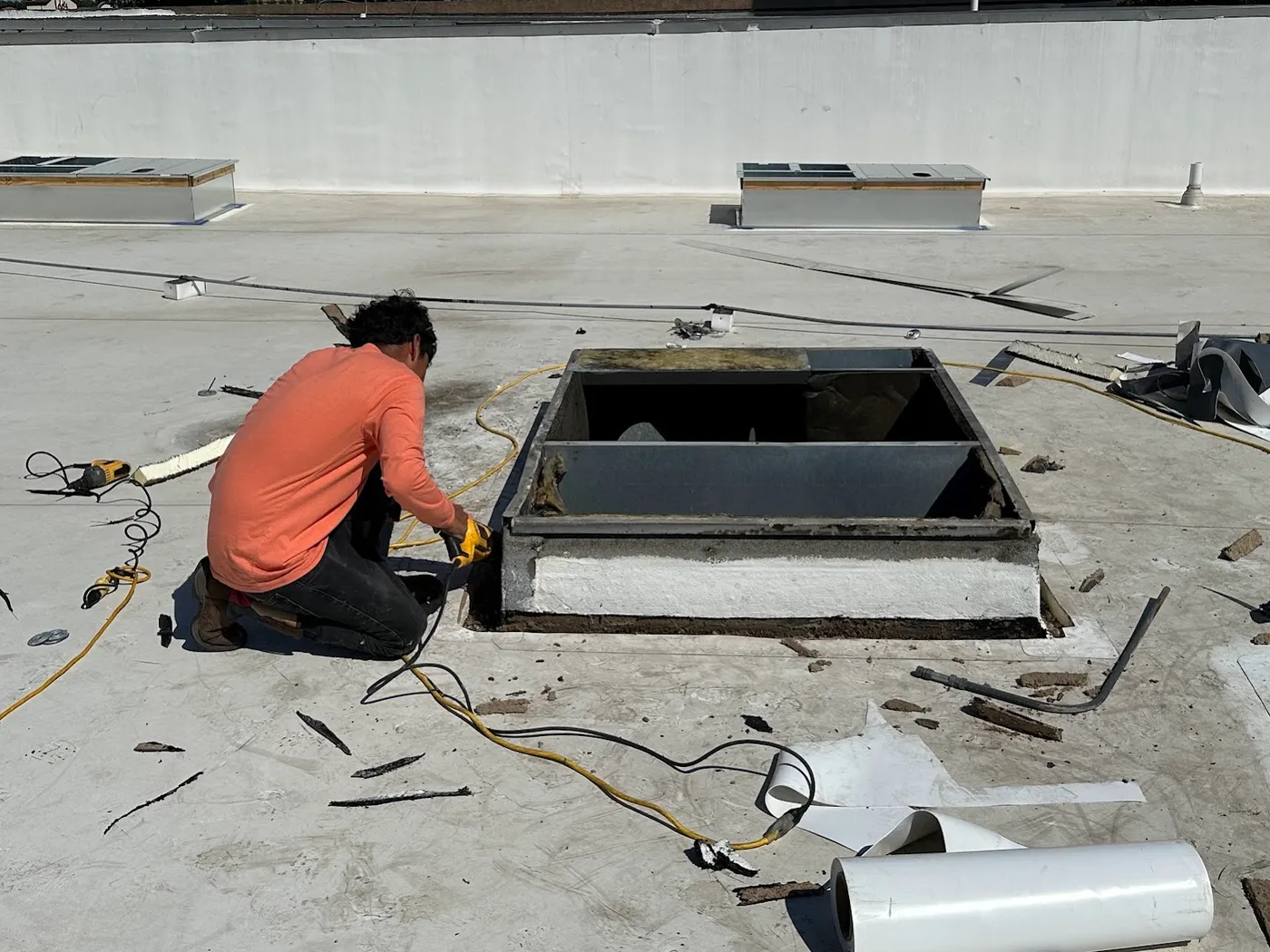
Temporary protection buys time. The permanent repair ends the leak, and it waits for a dry roof so it can be done properly. Nobody should be making a repair decision with a bucket on the floor.
A standard leak repair generally runs $1,500 to $3,500 in the Houston market. That covers the ordinary leak call at a seam, a curb, a wall flashing or a drain. The emergency visit and temporary protection are billed separately.
You get the photos, what we found, and the price of the permanent repair in writing before it starts. The failed detail comes out and gets built back, and wet insulation around it gets replaced. How that is done on each system is on our commercial roof repair page.
If the roof is under a manufacturer's warranty, check its terms on reporting a leak and on who may work on the roof first. In Galveston County, Brazoria County and Harris County east of State Highway 146, permanent repairs can need Texas windstorm certification (WPI-8) for TWIA wind coverage. We do WPI-8 certified work, so raise it before the repair is scheduled.
07
When a leak means more than a repair
Most leaks are one failed detail. Some are the first sign of something bigger. Leaks in several places that no single storm explains. Insulation wet across large sections, which the core cuts show. Membrane splitting in the open field, away from the details. Properly repaired details failing again. On metal, panels rusted through across the roof.
If the details are fixable and the surface is worn out everywhere, price commercial roof restoration, a coating system built over the existing roof. When widespread wet insulation or a failing deck rules that out, commercial roof replacement is the conversation to have, with the photos and numbers in front of you.
Once a leak is fixed, a commercial roof maintenance program keeps the next one small: clear drains, checked details and a dated record.
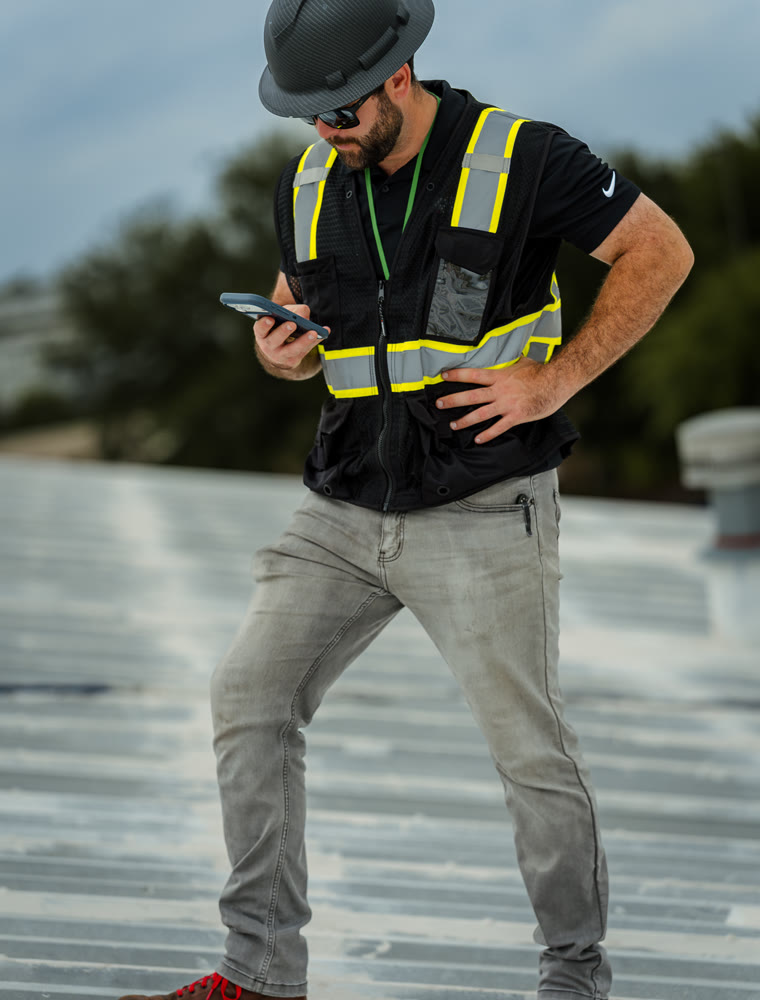
Who you are dealing with
Coons Roofing is a commercial-only roofing contractor working across the Houston metro. It is owned and run by Wade Coons, who is on every project from the first roof walk to the final walkthrough. There is no salesman between you and the person who looked at your roof.
Certified applicator for Versico, FiberTite, Duro-Last, Karnak, IPC, Western Colloid, Elevate and GAF. Fully insured with general liability and workers compensation coverage.
08
Commercial roof leak repair FAQs
How much does commercial roof leak repair cost in Houston?
A standard leak repair generally runs $1,500 to $3,500 in the Houston market, for the usual leak at a seam, a curb, a wall flashing or a drain. The price rises with how far the water has traveled, how much insulation is wet, how many details failed, the roof system and access. The emergency visit and temporary protection are billed separately. The permanent repair is priced in writing, with the photos behind it, before it starts.
How quickly can you respond for emergency roof repair?
Active water intrusion gets same-day emergency response, including after hours and weekends. If water is getting into the building now, call or text 713-367-1495 rather than using the form. The form is for anything that is not leaking, and it gets a reply within 24 hours, usually the same day.
Can you find a roof leak that has been patched before?
Usually. Old patches are one of the first places we look, because each one marks a spot that has leaked before. Often the patch went on in the wrong material, or above the stain instead of where the water gets in. We look under it rather than patching over it. Some leaks take more than one visit, and if yours does, we will tell you.
Is the leak coming from the roof or the HVAC unit?
It can be either. A drip on a dry day with the air conditioning running points at condensate. That is a clogged line or an overflowing drain pan, and it is your HVAC contractor's work. A drip that follows the rain points at the roof, very often the curb flashing under the unit. We look at the roof side, and if the water is not coming from the roof, we tell you that.
Can a commercial roof be repaired while it is raining?
Temporary protection can go on in the rain, when it is safe to be on the roof, never in lightning or high wind. Permanent repairs wait for a dry roof, because welded seams, adhered flashing and coatings need a clean, dry surface to hold. So an emergency usually runs in two steps: temporary protection now, and the permanent repair once the roof has dried.
Can you document roof leak and storm damage for insurance?
We photograph the entry points, the temporary protection and the rest of the roof, each photo dated, and write up what we found and what we did. You can forward that report to your insurer without changing it. Any claim is between you and your insurance company, and we do not give claim advice.
What if the ceiling or the roof deck is sagging?
Keep everyone out from under it and away from any electrical nearby. A ceiling holding water can come down suddenly. Once it is safe, we document a sagging roof deck and quote the structural repair, or work around it if the sag allows. Framing that has moved is a question for a structural engineer.

Leak stopped, but not sure it is fixed?
Tell us the building and where the water showed up. We walk the whole roof, photograph what we find, tell you where we believe the water was getting in, and put the permanent repair and its price in writing.
09
Where we work across the metro
We cover Harris, Fort Bend, Montgomery, Galveston, Brazoria, and Waller counties. Pick your city for local detail on what we see on roofs there.
Related services

Schedule a free roof assessment
We'll walk your roof, take photos, and give you straight answers. The assessment is free when we are quoting the work.
We reply within 24 hours, usually the same day. No pressure, no sales visit you did not ask for, and we never sell your information.